

UHT Milk Processing Line: Direct vs. Indirect Heating Technology, Modular Systems & Global Market Expansion in 2026


UHT Milk Processing Line: Direct vs. Indirect Heating Technology, Modular Systems & Global Market Expansion in 2026
Key Market Data
UHT Processing Market: $7.8B (2026) → $13.63B (2035) | CAGR 6.40% | UHT Equipment: CAGR 7.2% (2026–2033) | Sterilizer Market: $1.10B → $1.64B
Introduction: The Technology Choice That Shapes Your Entire Dairy Line
When a dairy processor begins planning a UHT milk production line, the first major decision is rarely about capacity or packaging format. It is about heating technology. Direct or indirect UHT — that single choice influences every downstream decision: product quality, energy consumption, operating costs, and the range of products the line can handle.
In 2026, this decision is more consequential than ever. The global UHT processing market, valued at $7.8 billion in 2026, is projected to reach $13.63 billion by 2035 — a compound annual growth rate of 6.40% — according to MarkWide Research. The milk UHT sterilizer segment alone, valued at $1.10 billion in 2025, is forecast to reach $1.64 billion in the coming years, driven by cold chain gaps in emerging markets and regulatory pressure forcing equipment upgrades in Europe.
This article examines the two heating technology paths, the rise of modular UHT systems transforming project timelines, the regional market forces reshaping procurement, and practical considerations for processors evaluating UHT line investments in 2026.
The UHT Processing Landscape in 2026
Ultra-high temperature processing — heating milk to 135–150°C for 2–8 seconds — remains the backbone of ambient dairy distribution worldwide. The technology enables milk to be stored at room temperature for 6–12 months without refrigeration, making it indispensable for markets where cold chain infrastructure is incomplete or unreliable.
Multiple research sources confirm the equipment market's upward trajectory. A June 2026 analysis by MarketScagr estimates the UHT milk processing equipment segment growing at 7.2% CAGR through 2033, fueled by consumer demand for shelf-stable dairy, rising disposable incomes in developing economies, and continuous innovation in heat exchanger and automation technology. PW Consulting's 2026 report on the milk UHT sterilizer segment points to a similar growth pattern: $1.10 billion in 2025 expanding to $1.64 billion.
Three forces are particularly shaping the 2026 market:
First, emerging market expansion. India — the world's largest milk producer — relies heavily on UHT technology because cold chain infrastructure remains sparse in rural and semi-urban areas. India's medium-sized dairy cooperatives, many processing under 50,000 liters per day, represent the fastest-growing buyer segment. Brazil tells a parallel story: the Northeast region (Ceará, Pernambuco, and neighboring states) has underpenetrated ambient milk distribution, creating a significant equipment deployment opportunity.
Second, the European regulatory overhaul. The EU F-Gas Regulation is accelerating the replacement of legacy refrigeration and heat pump systems in dairy plants across Germany, France, Italy, and the Netherlands. Processors are upgrading not just standalone equipment but entire UHT lines to meet new environmental standards — effectively shortening the replacement cycle in Europe's mature dairy market.
Third, premiumization driving technology choice. As consumers in developed markets gravitate toward premium, flavor-sensitive UHT products — organic milk, high-protein dairy beverages, specialty creams — processors are re-evaluating the technology at the heart of their lines: direct versus indirect heating.
Direct vs. Indirect UHT Heating: The Core Technology Decision
The distinction between direct and indirect UHT heating is not merely technical — it defines product quality, operational cost, maintenance complexity, and the product portfolio a line can support.
Indirect UHT Heating
Indirect systems use plate or tubular heat exchangers. The product and heating medium (hot water or steam) never come into direct contact. Heat transfers through metal surfaces — stainless steel plates in plate heat exchangers, or tube walls in tubular exchangers.
Advantages: These systems dominate high-volume commodity milk processing for good reason. They are mechanically simpler, require lower operator skill levels, and benefit from decades of incremental refinement. The profit pool in indirect heating lies in aftermarket service and replacement parts — plate gaskets, tube bundles, and pump seals. For a processor producing 100,000+ liters per day of standard white milk, indirect UHT remains the most cost-efficient technology path.
Limitations: The indirect heat transfer path creates a temperature gradient between the heating surface and the product. This gradient can degrade volatile flavor compounds in sensitive products, producing the "cooked" note that premium milk brands work hard to avoid. For this reason, indirect systems face limitations in high-end dairy applications where flavor fidelity is a competitive differentiator.
Direct UHT Heating
Direct systems inject culinary steam directly into the product (steam injection) or disperse the product into a steam-filled chamber (steam infusion). The product heats nearly instantaneously — within fractions of a second — then passes through a vacuum chamber where flash cooling removes the added water.
Advantages: Direct heating is the fastest-growing segment in the UHT equipment market, according to MarkWide Research. The near-instantaneous heating profile preserves volatile flavor compounds that indirect systems degrade. This makes direct UHT the preferred technology for premium milk, flavored dairy beverages, creams, and infant formula bases — products where consumers notice and pay for superior taste. Denmark and the Netherlands, both markets with sophisticated dairy consumers, are seeing the strongest adoption of direct UHT for premium product lines.
Limitations: Direct systems carry higher capital cost and greater operational complexity. The steam injection/infusion process requires precise control of steam purity, temperature deltas, and vacuum chamber conditions. Operator training requirements are higher. The energy cost per liter processed is typically higher than indirect — though this is offset in premium segments by higher product margins.
Side-by-Side Comparison
| Factor | Indirect UHT (Plate/Tubular) | Direct UHT (Injection/Infusion) |
|---|---|---|
| Heating mechanism | Heat transfer through metal surfaces | Steam directly contacts product |
| Heating speed | Seconds (gradient heating) | Fraction of a second (instantaneous) |
| Flavor preservation | Moderate — may produce "cooked" notes | Excellent — near-fresh taste profile |
| Best application | Commodity white milk, high-volume standard products | Premium milk, flavored dairy, creams, infant formula |
| Capital cost | Lower initial investment | Higher initial investment |
| Operating complexity | Lower — simpler operation and maintenance | Higher — requires steam purity control, vacuum management |
| Energy per liter | Lower (but may need downstream homogenization energy) | Higher (offset by premium product margins) |
| Product range flexibility | More limited — best for single-product or similar-product lines | Broader — handles varying viscosities and heat sensitivities |
| Market segment growth | Mature, steady — profit in aftermarket service | Fastest-growing — driven by premiumization |
Making the Choice: What Drives the Decision
In practice, the choice between direct and indirect UHT is rarely driven by technology preference alone. It is shaped by three practical questions:
1. What products will this line run? A processor producing standard white milk for commodity markets should lean toward indirect UHT. A processor planning to run premium organic milk, flavored dairy beverages, and specialty creams on the same line should seriously evaluate direct UHT — the flavor advantage directly impacts shelf price.
2. What is the target market's quality expectation? In markets where consumers are price-sensitive and less attuned to subtle flavor differences, indirect UHT delivers adequate quality at lower cost. In markets where consumers are willing to pay a premium for taste — Scandinavia, Western Europe, urban centers in Asia-Pacific — direct UHT can justify its higher cost through better margins.
3. What operator skill level is available? Indirect systems are more forgiving. Direct systems demand operators who understand steam quality, vacuum dynamics, and automated process control. In regions where skilled dairy technicians are scarce, this consideration alone may favor indirect technology — or favor an equipment supplier who includes comprehensive operator training as part of the package.
Modular UHT Systems: The Six-Month Revolution
One of the most significant practical developments in UHT equipment procurement is the emergence of modular, skid-mounted UHT systems. These pre-assembled, containerized units are transforming project economics for medium-scale processors.
Traditional UHT line installation has historically been a major bottleneck. From ground-breaking to first production run, a conventional installation cycle spans 18 to 24 months. This timeline includes civil works, equipment delivery, on-site assembly, piping, electrical integration, commissioning, and validation. For a growing dairy processor, waiting two years for a new line to come online represents a significant opportunity cost.
Modular UHT systems compress this timeline dramatically — to approximately 6 months. The system arrives on-site as a pre-commissioned, factory-tested unit requiring primarily utility connections and local regulatory validation. This approach is gaining particular traction among medium-sized dairy cooperatives in India and Southeast Asia, where rapid capacity expansion is a competitive imperative.
Equipment suppliers are also innovating on the commercial side. Some vendors now offer "rent-to-own" financing structures that reduce the upfront capital barrier for smaller processors. This model — where the processor pays an initial fee followed by monthly installments that eventually convert to ownership — has proven effective in markets where bank financing for dairy equipment can be difficult to secure.
A parallel trend is the "decoupling" of aftermarket services. Major equipment suppliers are increasingly separating thermal validation, spare parts logistics, and remote diagnostics into independent service contracts. This allows processors to pay for exactly the support level they need — from basic parts supply to full performance-based service agreements — rather than bundling everything into the initial equipment purchase.
Capacity Planning: Matching Line Scale to Market Reality
UHT lines span a wide capacity range, and matching capacity to market demand is as important as choosing the right technology.
| Capacity Tier | Daily Throughput | Typical Processor Profile | Equipment Configuration |
|---|---|---|---|
| Small-scale | 1,000–5,000 L/day | Regional dairy, niche premium brand, pilot plant | Compact indirect plate system; modular skid-mounted option; semi-automatic CIP |
| Medium-scale | 5,000–50,000 L/day | Dairy cooperative, mid-market processor, multiple SKU producer | Indirect tubular or plate; consider direct for premium product lines; full CIP integration; modular architecture recommended |
| Large-scale | 50,000–200,000 L/day | National dairy brand, multi-plant operator | Multiple parallel lines; mix of direct (premium) and indirect (commodity); high automation; integrated aseptic filling; full SCADA/MES |
| Industrial-scale | 200,000+ L/day | Global dairy group, export-oriented processor | Custom-engineered multi-line configuration; dedicated utility plant; advanced energy recovery; IoT-enabled predictive maintenance |
For small to medium processors, a modular approach offers particular advantages. A 5,000 L/day modular UHT unit can be operational in roughly 6 months, generating revenue while the processor evaluates demand before committing to a larger permanent installation. This "test the market" strategy reduces risk in developing dairy regions where consumption patterns are still evolving.
2026 Technology Trends Shaping UHT Line Design
1. ESL Technology as a Strategic Alternative
Extended Shelf Life (ESL) pasteurization operates at lower temperatures than UHT and is gaining ground in markets with reliable cold chains. ESL milk retains a fresher taste profile than UHT while still achieving 21–45 days of refrigerated shelf life. In Western Europe and North America, where refrigeration infrastructure is universal, ESL is increasingly preferred by consumers who perceive it as less "processed" than UHT. For equipment buyers, this means a UHT line investment must be evaluated in the context of the target market's cold chain maturity — in a fully refrigerated market, ESL may be the more competitive technology choice.
2. Energy Recovery Becomes Non-Negotiable
UHT processing is energy-intensive. Heating milk to 135–150°C and then cooling it back to filling temperature consumes substantial thermal and electrical energy. Modern UHT lines increasingly incorporate regenerative heat exchange — using hot product exiting the holding tube to pre-heat incoming cold milk — recovering 85–94% of thermal energy. In Europe, where energy costs have remained elevated since 2022 and EU environmental regulations are tightening, regenerative efficiency is moving from "nice to have" to a core equipment specification.
3. Automation and Real-Time Process Control
Modern UHT lines embed sensors throughout the thermal process — monitoring temperature, flow rate, holding time, and pressure at multiple points. This data feeds into programmable logic controllers that make micro-adjustments to maintain product within specification. The practical benefit for processors is consistent product quality across shifts and reduced reliance on operator intuition. Newer systems also integrate remote diagnostics, allowing equipment suppliers to identify developing issues before they cause unplanned downtime.
4. Flexible Packaging Integration
The packaging end of a UHT line is evolving rapidly. While aseptic cartons (Tetra Brik, Combibloc) remain the dominant format globally, processors increasingly demand multi-format capability: the ability to fill aseptic pouches, PET bottles, and portion packs on the same line. This flexibility allows processors to serve different market segments — family-size cartons for retail, single-serve pouches for foodservice, small-format packs for school programs — without operating separate lines. Equipment suppliers are responding with faster format changeover systems and modular filling stations that can be added or reconfigured as market needs shift.
5. The India-Brazil Growth Corridor
If the 2010s were defined by UHT expansion in China, the mid-to-late 2020s belong to India and Brazil. India's rural UHT milk consumption is rising as distribution networks penetrate deeper into areas without reliable cold storage. Brazil's Northeast region — with its hot climate and underdeveloped refrigerated logistics — represents one of the world's largest untapped ambient milk markets. Equipment suppliers who understand the specific needs of these markets — compact footprint, minimal operator dependency, financing flexibility — are best positioned to capture growth in this corridor.
Four Common UHT Line Design Errors
Processors planning UHT line investments frequently encounter four preventable problems:
1. Over-specifying capacity without demand validation. A line sized for 100,000 L/day that runs at 40% utilization ties up capital and generates unnecessary overhead. The most successful UHT projects start with conservative capacity that matches confirmed demand, with a modular architecture that allows expansion.
2. Ignoring utility infrastructure costs. A UHT line requires steam generation, chilled water, compressed air, and electrical supply. Processors who budget only for the UHT equipment — and not the supporting utility plant — routinely exceed project budgets by 20–30%. The utility infrastructure cost should be modeled in parallel with equipment selection, not as an afterthought.
3. Choosing technology based on current product alone. A processor running only white milk today may need cream, flavored milk, or plant-based beverages in three years. Indirect UHT optimized for white milk at one viscosity may struggle with cream at a different viscosity or with plant-based formulations that behave differently under heat. Evaluating the line's product range flexibility during the design phase is far cheaper than retrofitting later.
4. Underestimating operator training needs. The gap between a dairy that has never run UHT and one that runs it reliably is wide — and it is bridged by operator training, not equipment specifications alone. Processors who invest in comprehensive training programs during commissioning see faster ramp-up to stable production and fewer quality incidents in the first year of operation.
Supplier Selection: What to Evaluate Beyond the Specification Sheet
Equipment specifications look similar across suppliers. What differentiates outcomes is what happens after installation.
Process engineering support: Does the supplier send engineers to study your existing facility, understand your product range, and design the line around your specific conditions? Or do they offer a standard configuration with minimal adaptation?
Commissioning depth: How many production days does the supplier commit to on-site during commissioning? A supplier who spends two weeks running real product through the line alongside your operators delivers a fundamentally different result from one who validates the system with water and departs.
After-sales response: What is the guaranteed response time for technical support? For a medium-scale processor in a developing market, a 48-hour guaranteed remote response — with escalation to on-site support when needed — can mean the difference between a minor disruption and days of lost production.
Training commitment: Does the supplier offer structured operator and maintenance training, or does training consist of informal knowledge transfer during commissioning? Formal training programs with documented curricula produce measurably better long-term outcomes.
Conclusion: The Line That Fits Your Market
The best UHT milk processing line is not the one with the most advanced specifications — it is the one that matches the processor's products, market, operator capabilities, and growth trajectory. In 2026, that means evaluating direct versus indirect heating technology based on product portfolio, not just throughput; considering modular architecture for faster deployment and lower upfront risk; and selecting a supplier partnership that extends meaningfully beyond equipment delivery.
Planning a UHT Milk Processing Line?
SD Henger Group provides complete UHT milk processing line solutions — from receipt and standardization through UHT sterilization, aseptic filling, and packaging. Our engineering team works with you to evaluate direct vs. indirect heating options, capacity matching, and modular design to develop a configuration that fits your products and market. Contact us today to discuss your UHT processing requirements. Visit www.sdhengergroup.com to learn more.
Related News
-
-
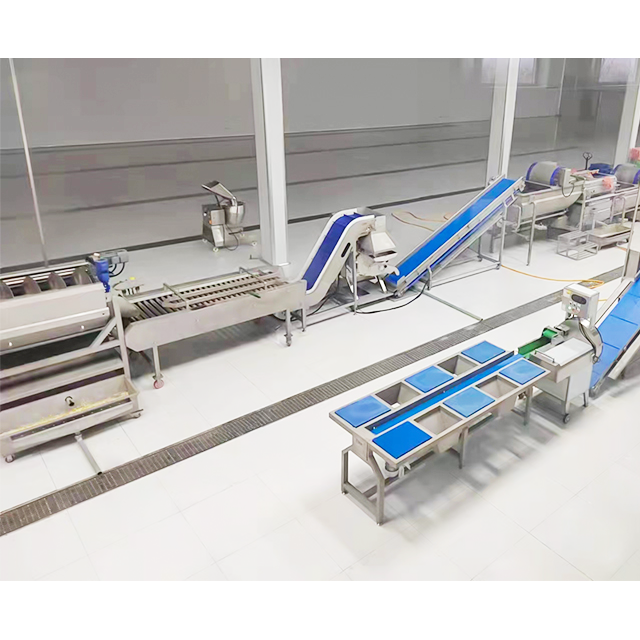 This article explores fruit and vegetable washing line design for 2026, focusing on organic produce compliance, post-wash drying, and optical sorting. It compares bubble, brush, spray, and ultrasonic washing technologies; explains air-knife and centrifugal drying; outlines four capacity tiers; and identifies five industry trends and five common purchasing errors. The guide is written for processors serving organic, fresh-cut, and export markets who need practical, mechanical equipment selection advice.Industry Insights
 -
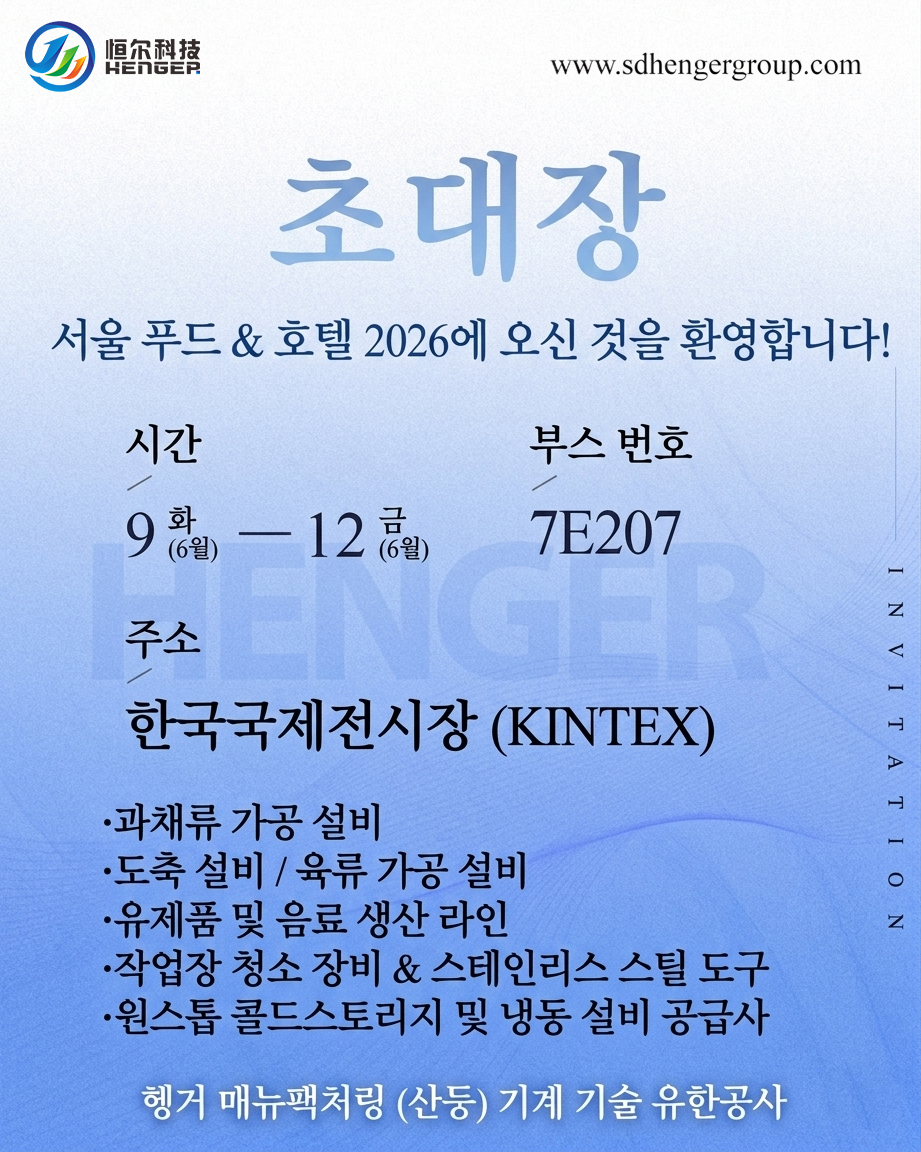 You're Invited: Meet Henger at Seoul Food & Hotel 2026!안녕하세요,We are thrilled to invite you to connect with Henger Manufacturing (Shandong) Machinery Technology Co., Ltd. at the upcoming Seoul Food & Hotel 2026, the premier food processing and hospitality industry event in South Korea! Event DatCompany Dynamic
