

Meat Cutting & Processing Line: How to Design a High-Yield, Labor-Smart Configuration in 2026


Meat Cutting & Processing Line: How to Design a High-Yield, Labor-Smart Configuration in 2026
Published: June 5, 2026 | Category: Meat Processing Equipment | Author: SD Henger Group
Introduction: The Line Design Challenge
The global meat processing equipment market reached USD 18.08 billion in 2026, projected to expand at a 6.36% CAGR to USD 31.49 billion by 2035. Within this growth curve, no operation matters more than the cutting and processing line — the value-conversion point where carcasses become saleable products, and where profit margins are won or lost.
When a processor begins planning a new cutting line, they face not a shopping list of machines, but a chain of interconnected design decisions: portioning accuracy affects yield, equipment sequencing affects takt time, and automation levels directly determine labor requirements. One poorly configured station drags down the entire line.
This article provides a configuration framework — how to think through station workflow, equipment selection, yield optimization, and labor strategy — rather than a generic equipment catalog.
The Five-Stage Workflow of a Cutting & Processing Line
A complete cutting and processing line consists of five core station stages. Understanding the functional boundaries of each stage is the starting point for intelligent line design.
Stage 1: Portioning
Portioning is the entry station of the cutting line — where carcasses or primal cuts are divided into fixed-weight standardized portions. This is the first gatekeeper of final yield.
Core equipment includes band saws, circular saws, and automated portioning machines. For medium-to-large lines, automatic portioning systems are gaining traction rapidly — the automatic meat portioning machine market is growing at a 10.4% CAGR through 2033. Modern portioning machines integrate load cells and vision alignment systems, dynamically adjusting cutting paths based on the 3D geometry of each incoming piece to minimize trim loss.
The critical decision at this stage: fixed-weight or fixed-dimension portioning? The former suits retail packaging; the latter works for foodservice wholesale. The line must align its portioning strategy with the end market.
Stage 2: Deboning
Deboning — separating skeletal structures from muscle tissue — remains one of the most labor-intensive stations on any processing line. Variable bone shapes and complex muscle attachment structures make it a stubborn automation challenge.
Equipment options span three tiers: manual deboning tables (with circular knives and pneumatic shears), semi-automated deboning machines (for specific cuts like shoulder blade separation), and fully automated deboning systems (robotic deboning cells for high-throughput applications such as poultry breast).
The deboning yield gap is the single largest profit variable on the line. A trained deboning specialist can outperform a novice by 3-5% in meat recovery — a meaningful revenue difference at high throughput.
Stage 3: Slicing
Slicing transforms deboned meat blocks into specified-thickness slices, strips, or dices — the operation most directly tied to final product format.
Equipment selection depends on product type: fresh meat uses high-speed slicers with continuous feed systems; frozen meat requires cryogenic slicers (processing at -3°C to -5°C semi-frozen state); bacon and cooked meats demand high-precision slicers with thickness control down to sub-millimeter accuracy.
A defining 2026 trend: approximately 37% of new cutting equipment incorporates vision-based precision control. The system scans incoming product geometry in real time, dynamically adjusting slice angle and thickness to achieve unprecedented product uniformity.
Stage 4: Grinding & Blending
For further-processed products — sausages, patties, meatballs — grinding and blending form the core operation. The typical station sequence runs: pre-breaking → metal detection → fine grinding → mixing/seasoning → emulsification (if needed).
Grinding equipment is graded by plate hole size and throughput: coarse grind (8-13mm) for initial breakdown, medium grind (4.5-6mm) for standard products, fine grind (2-3mm) for emulsified products. Temperature control is the critical blending-stage factor — meat temperature must remain at 0-2°C during grinding and mixing; exceeding 4°C seriously degrades texture and shelf life.
Efficient lines integrate in-line fat analyzers between grinding and blending stations, enabling real-time lean-to-fat ratio adjustments for consistent batch specifications.
Stage 5: Forming & Packaging
The final stage shapes processed meat into finished product forms (patties, meatballs, sausages) and packages them.
Forming machines press ground meat into uniform shapes and weights. Modern formers feature interchangeable molds for rapid switching between patty, meatball, and chunk formats. High-speed vacuum fillers — adopted by approximately 28% of large-scale producers — handle sausage and emulsified product lines.
Packaging connects directly to the forming output: vacuum packaging machines (for fresh and frozen products) and modified atmosphere packaging (MAP) machines (for chilled retail products) represent the two main paths. Approximately 63% of US manufacturers have upgraded to automated slicing and packaging lines, achieving continuous flow from forming to case-ready output.
Five Yield Optimization Strategies
Every 1% yield improvement on a cutting line translates to meaningful annual revenue for medium-to-large operations. Here are five proven strategies:
- Dynamic cutting paths at portioning. Don't use fixed cutting programs. 3D-scan-based dynamic cutting paths adjust the cut plane to each piece's geometry in real time, reducing trim loss from the traditional 3-5% down to 1-2%. This maps directly to industry data — one leading supplier's digital portioning system achieved 29% precision improvement and 22% waste reduction.
- Human-machine collaboration at deboning. Fully automated universal deboning remains immature, but assistive tools significantly narrow the operator-to-operator yield gap. Powered deboning knives, height-adjustable workstations, and in-line video training systems deliver the highest ROI among deboning station upgrades.
- Closed-loop weighing feedback at slicing. Connect precision slicers with dynamic checkweighers in a closed-loop control system. The scale feeds each slice weight back to the slicer controller, which micro-adjusts subsequent cut thickness. This configuration lifts slice weight compliance from approximately 90% to above 98%.
- Cold chain management at the grinding-blending interface. Insert a plate heat exchanger pre-chilling stage between the grinder and mixer, ensuring meat enters blending at a stable 0-1°C. This is more reliable than relying solely on jacketed equipment cooling — particularly critical for emulsified products.
- End-of-line data traceability. Position an in-line vision inspection station before packaging, recording weight, dimensions, and appearance data for every unit. This serves quality rejection while providing station-level yield analytics — the data will show which operation generates the most waste.
Labor-Smart Design: Choosing Between Semi-Automated and Fully Automated
In 2026, 46% of processors report increasing difficulty recruiting skilled technicians, and 42% face downtime from deferred maintenance. In this context, automation decisions are not merely technical — they are risk hedges.
But "fully automated" is not the optimal answer for every scenario. Here is a pragmatic configuration framework:
| Scenario | Recommended Automation | Rationale |
|---|---|---|
| Poultry breast deboning, single-format high throughput | High (>80% automated) | Repetitive motion, consistent product geometry delivers rapid ROI |
| Beef/pork complex deboning and portioning | Mixed (40-60% automated) | Variable anatomy; full automation payback period too long |
| Flexible line with frequent product changeovers | Mixed (40-60% automated) | Semi-auto equipment switches faster; moderate operator skill requirement |
| Emerging markets with manageable labor cost | Moderate (30-50% automated) | Labor cost controllable; maintenance capability still building |
| Fast-food chain supplier with extreme weight precision requirements | High (>80% automated) | Consistency requirements justify automation investment |
Core principle: automation doesn't replace people — it amplifies good operators' output. Semi-automated assist equipment can help a skilled deboning specialist increase daily throughput by 30-50% while maintaining meat recovery rates — often more economically viable than a full automation approach.
The Six-Question Procurement Decision Framework
When a processor begins procuring a cutting and processing line, these six questions form the decision framework:
- What is the end product? Retail portion cuts, foodservice wholesale blocks, or further-processing raw material — different end products demand entirely different equipment sequences.
- What is the target daily throughput? This is the base parameter for line scale and automation level. Annual capacity is a poor design input — calculate by daily throughput to align with shift patterns and takt time.
- What is the incoming material condition? Hot-boned fresh, chilled, or frozen? Different conditions demand different cutting approaches and equipment configurations.
- How frequent are product changeovers? Does the same line need to handle multiple species (pork/beef/poultry)? Multi-species co-production requires more flexible configurations and faster changeover design.
- What is the available workforce profile? How many skilled cutters and deboners? What is the maintenance technician capability level? The workforce profile directly shapes automation decisions.
- What are the facility constraints? Floor area, cold chain configuration, utility supply — these physical constraints determine line layout and throughput ceiling.
2026 Cutting Line Technology Trends
Waterjet cold cutting gains ground. High-pressure waterjet cutting eliminates blades, carries zero cross-contamination risk, and generates no cutting heat — a significant advantage for preserving meat texture and extending shelf life. While equipment investment is higher, adoption is accelerating in premium fresh meat and deli processing.
Vision-guided precision becomes standard. 37% of new cutting equipment incorporates vision-based precision control. This proportion could double within 3-5 years. The core driver: increasingly stringent retail-side weight consistency requirements.
Modular line design becomes mainstream. More processors are gravitating toward modular equipment configurations — lines that can be procured in phases, installed in segments, and upgraded progressively. This "build the skeleton first, add muscle later" approach reduces initial investment risk.
Energy efficiency becomes a hard selection criterion. Approximately 36% of producers now list energy and water consumption as core equipment selection metrics. While cutting equipment itself has moderate energy draw, the accompanying refrigeration and sanitation systems are the real consumers — integrated design becomes the differentiator.
Skills training becomes an intrinsic line component. 31% of companies invest heavily in workforce upskilling for modern equipment operation. The equipment supplier's role is evolving from "selling machines" to "delivering operational capability and maintenance capacity."
Common Line Design Mistakes
These five mistakes are the most frequent — and the most avoidable:
- Selecting equipment by lowest unit price. Mismatches between stations (upstream faster than downstream, insufficient buffer capacity) create efficiency losses far exceeding any procurement-stage savings.
- Neglecting material handling. Conveyors, transfer tables, and buffer zones between stations appear to be "auxiliary equipment" — but poor design causes takt time disruption and cross-contamination.
- Overestimating maintenance capability. Choosing equipment requiring high-frequency precision maintenance without the corresponding technical team capability — this is the root cause of downtime at 42% of plants.
- No expansion space reserved. 32% of processors need capacity expansion within 18-24 months of commissioning — but plant and line layout leave no flexible space.
- Ignoring cold chain integration. The cutting room must be maintained below 10-12°C, but cutting equipment generates heat — refrigeration load calculations must incorporate equipment heat dissipation.
Conclusion
An excellent cutting and processing line is not a collection of machines — it is the systematic integration of station workflow, yield optimization, labor strategy, and facility constraints. Proper line design can lift yield by 2-3% while reducing labor dependency by 30-50% — numbers that translate to substantial real-world returns.
For processors planning a new or upgraded cutting line, start with the five-stage workflow and six procurement decision questions to build clear configuration logic. Every decision should be guided by end product and target throughput, constrained by actual labor conditions.
Plan Your Cutting & Processing Line with SD Henger Group
SD Henger Group delivers complete cutting and processing line solutions for meat processors worldwide — covering portioning, deboning, slicing, grinding, and packaging across pork, beef, sheep/goat, and poultry species. We collaborate with clients to design line configurations where every station's equipment selection aligns with the overall efficiency target.
To discuss your cutting line planning, contact the SD Henger Group team — we welcome the opportunity to provide design recommendations and technical solutions tailored to your specific requirements.
Visit www.sdhengergroup.com to explore our full range of meat processing equipment and line solutions.
Related News
-
-
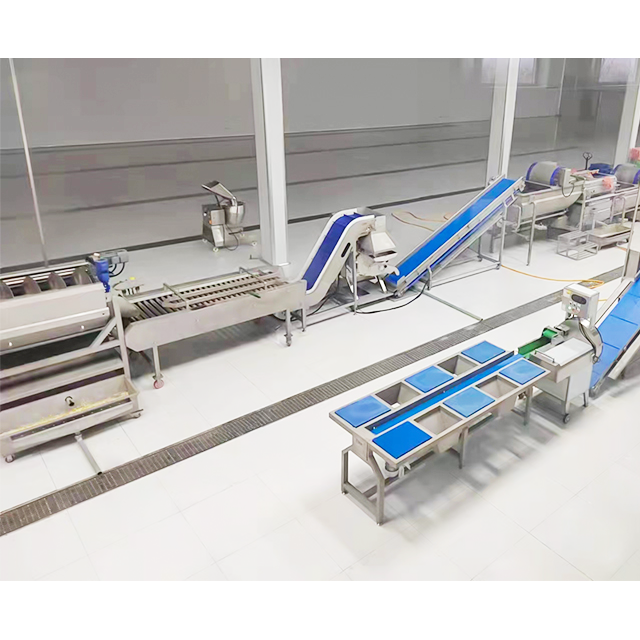 This article explores fruit and vegetable washing line design for 2026, focusing on organic produce compliance, post-wash drying, and optical sorting. It compares bubble, brush, spray, and ultrasonic washing technologies; explains air-knife and centrifugal drying; outlines four capacity tiers; and identifies five industry trends and five common purchasing errors. The guide is written for processors serving organic, fresh-cut, and export markets who need practical, mechanical equipment selection advice.Industry Insights
 -
 You're Invited: Meet Henger at Seoul Food & Hotel 2026!안녕하세요,We are thrilled to invite you to connect with Henger Manufacturing (Shandong) Machinery Technology Co., Ltd. at the upcoming Seoul Food & Hotel 2026, the premier food processing and hospitality industry event in South Korea! Event DatCompany Dynamic
