Cattle Slaughter Hide Processing & Beef Aging Technology: Equipment Design for Modern Abattoirs in 2026
The global beef processing equipment market continues its upward trajectory, with the sector heading toward significant expansion as processors invest in hide recovery infrastructure and carcass conditioning systems. Two areas increasingly define operational profitability in cattle slaughter: the hide processing chain — where proper skinning, fleshing, and preservation turn a by-product into a revenue stream — and beef aging technology, where wet and dry conditioning directly affect meat quality, shelf life, and market positioning. This guide examines both sub-systems in detail, covering equipment selection, chamber design, EUROP carcass classification, and capacity planning for modern abattoirs operating in 2026.
Hide Processing Chain: From Hide Pulling to Preservation
Mechanical Hide Pulling Systems
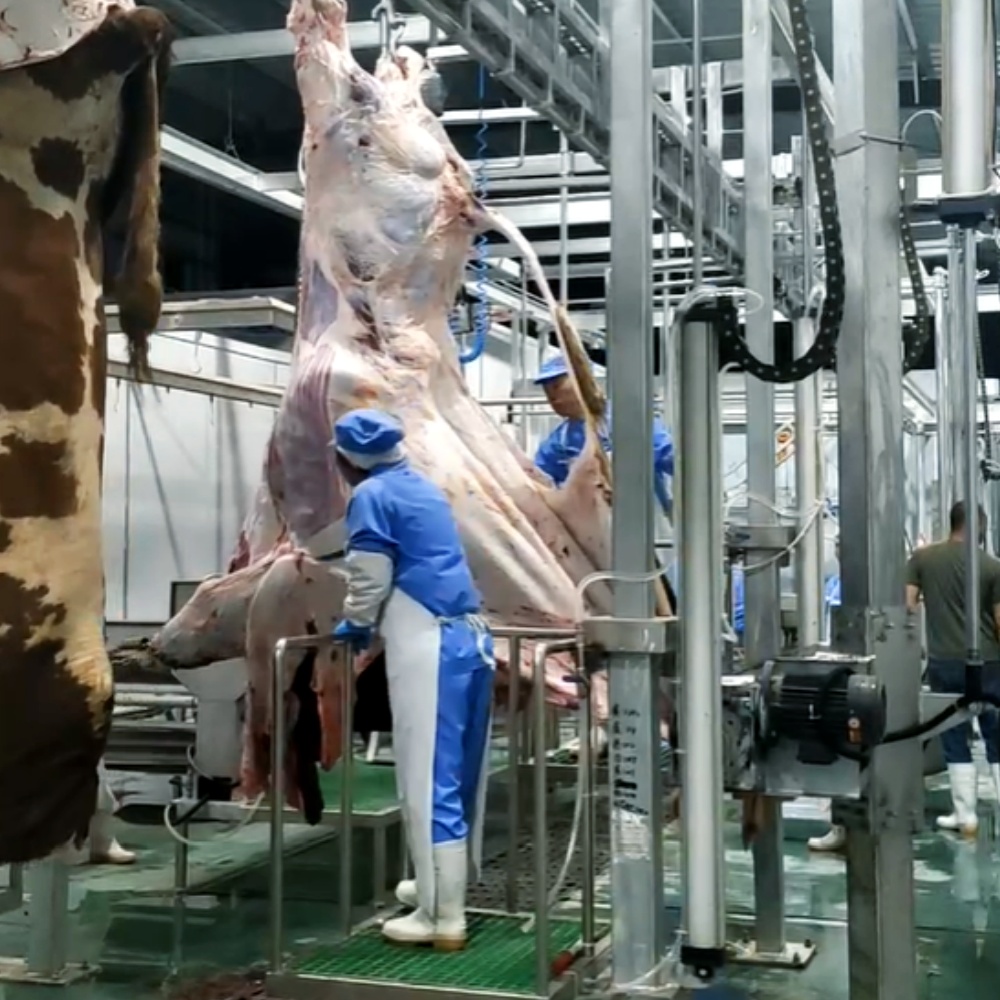
Hide removal is one of the most labor-intensive and skill-dependent stages in cattle slaughter. Modern abattoirs employ hydraulic hide pullers that secure the hind legs via chain attachments and drive a drum vertically with hydraulic power, completing the skinning process with manual assistance. These systems pair with stepped carcass processing conveyors that maintain carcass position during pulling, reducing operator strain and improving hide integrity.
Key performance parameters for hide pullers include pulling force (typically 8-15 tonnes for adult cattle), cycle time (45-90 seconds per carcass depending on breed and hide condition), and hide damage rate (well-adjusted systems achieve less than 3% surface scoring). The choice between single-drum and dual-drum pullers depends on throughput requirements: single-drum units suit plants processing fewer than 80 head per day, while dual-drum configurations support higher-volume operations with parallel carcass handling.
Hide quality directly correlates with leather market value. A single branded steer hide contributes approximately $1.50 per hundredweight of live weight to by-product revenue, making proper pulling technique one of the most consequential skill areas on the slaughter floor.
Fleshing and Hide Grading
After pulling, hides enter fleshing machines that remove subcutaneous fat and connective tissue from the inner surface. Fleshing quality determines whether a hide qualifies for top-grain or full-grain leather processing. Fleshing machines use cylindrical knives with adjustable gap settings, typically processing 4-8 hides per hour depending on size and thickness.
Hide grading follows fleshing and classifies each hide by weight, thickness, defect count (brands, scratches, parasitic damage), and surface area. The global cow leather market, valued at approximately $23 billion in 2026, segments into top-grain, full-grain, split, and corrected-grain categories — each commanding different price tiers. Asia-Pacific processes the largest share of cattle hides globally, accounting for roughly 48% of market value, with China and India as primary processing hubs.
Hide Preservation for Leather Markets
Fresh hides begin degrading within hours of removal. Three preservation methods are common in modern operations:
- Salting: The most widely adopted method, applying coarse salt at 30-40% of hide weight. Salting reduces moisture content and inhibits bacterial growth, preserving hides for 3-6 months before tanning.
- Brining: A salt-solution immersion process that achieves faster and more uniform penetration than dry salting, suited for larger operations with batch processing capability.
- Chilling: Cold storage at 2-4°C for short-term preservation (up to 7 days), appropriate for plants with nearby tannery access or direct delivery logistics.
The choice depends on logistics, storage duration, and destination tannery requirements. Plants exporting to distant markets should prioritize salting or brining, while domestic supply chains may use chilling to reduce salt handling costs.
Beef Carcass Conditioning: Wet Aging vs Dry Aging Equipment
Wet Aging (Vacuum-Packaged Conditioning)
Wet aging remains one of the most widely adopted conditioning methods globally. Carcass halves or primal cuts are vacuum-sealed in barrier bags and held at 0-4°C for 14-28 days. Enzymatic proteolysis proceeds within the sealed environment, tenderizing muscle fibers without moisture loss or surface mold development. Wet aging delivers several operational advantages: no trim loss from desiccation, 30-40% faster inventory turns compared to dry aging, and lower spoilage risk in humid climates.
Equipment requirements for wet aging include vacuum sealing machines (chamber or nozzle types), chilling rooms maintained at 0-4°C with moderate air circulation, and inventory tracking systems that manage aging duration per batch. Modern chamber vacuum sealers handle 8-15 primal packages per cycle, with bag material specifications calling for oxygen transmission rates below 50 cc/m²/24h for adequate barrier performance.
Dry Aging Chamber Design
Dry aging subjects uncovered carcass halves or primal cuts to controlled temperature, humidity, and airflow for periods ranging from 21 to 120 days. The process relies on three simultaneous mechanisms: enzymatic tenderization through calpain and cathepsin activity, moisture evaporation concentrating flavor compounds, and controlled surface mold development contributing characteristic umami depth.
Chamber design specifications are critical to successful dry aging:
- Temperature: 1-3°C (34-38°F), with variance tolerance of ±0.5°C across the chamber volume
- Relative humidity: 80-85%, balancing controlled desiccation against spoilage risk — readings below 75% accelerate excessive trim loss, while readings above 90% encourage pathogenic surface growth
- Air velocity: 0.5-2.0 m/s across carcass surfaces, ensuring uniform evaporation without localized drying or condensation zones
- UV-C sterilization: Increasingly integrated into modern aging chambers to reduce surface microbial load without affecting enzymatic processes
The global dry aging beef market was valued at approximately $2.95 billion in 2026 and is projected to reach $4.19 billion by 2034, growing at a CAGR of 4.5%. North America leads demand, while Asia-Pacific shows the fastest growth rate.
Dry aging yield loss ranges from 15-30% of original carcass weight, with the higher end corresponding to extended aging beyond 45 days. This trim factor means processors should allocate sufficient carcass inventory and pricing margin recovery before committing to long-duration programs.
Conditioning Room Temperature and Airflow Control
Whether wet or dry, every conditioning room requires precise climate management. Evaporator selection should account for the specific heat load: carcass cooling from 39°C (post-slaughter body temperature) to 4°C within 24 hours in initial drawdown rooms, followed by steady-state maintenance at conditioning temperatures. Drawdown rooms typically operate at -2 to 0°C with high airflow (3-5 m/s) for rapid heat removal, while conditioning rooms use lower velocity (0.5-2.0 m/s) to avoid surface desiccation in dry aging or condensation on vacuum bags in wet aging.
Multi-zone designs separating drawdown from conditioning allow simultaneous processing of newly slaughtered carcasses alongside aging inventory. This two-room approach is recommended for plants processing more than 50 head per day, as it prevents temperature fluctuations that can compromise aging consistency.
EUROP Carcass Classification: Manual vs Automated Grading
The SEUROP classification system provides a standardized framework for assessing beef carcass value across EU member states and countries adopting EU standards. The system evaluates two primary attributes:
Conformation (muscling and shape): Six classes — S (outstanding), E (excellent), U (very good), R (good), O (sufficient), P (weak). These describe the profile of shoulder, back, and leg development.
Fat cover: Five classes — 1 (very lean) through 5 (very fat), assessed visually on the external surface and intermuscular fat distribution.
| SEUROP Class | Conformation | Typical Price Impact |
|---|---|---|
| S | Outstanding muscling | Top premium tier |
| E | Excellent conformation | High premium |
| U | Very good muscling | Premium above baseline |
| R | Good — reference class | Market baseline |
| O | Sufficient | Discount from baseline |
| P | Weak muscling | Lowest value |
Manual grading relies on trained inspectors and remains common in smaller facilities. However, automated grading systems using multi-view stereo imaging can classify both carcass halves simultaneously at line speeds up to 620 half carcasses per hour, achieving classification accuracy above 99% with non-contact measurement that eliminates cross-contamination risk. Automated systems also predict primal and commercial cut weights, enabling payment based on actual commercial value rather than visual scoring alone.
Capacity Planning: Hide Processing & Aging Room Sizing
| Parameter | Small (20-50 head/day) | Medium (50-150 head/day) | Large (150-400 head/day) | Distribution Hub (400-1000 head/day) |
|---|---|---|---|---|
| Hide puller type | Single-drum hydraulic | Single-drum with assist conveyor | Dual-drum parallel | Dual-drum + automated fleshing line |
| Fleshing capacity | Manual / single-knife unit | 1 fleshing machine | 2 fleshing machines (batch) | 3+ fleshing machines (continuous) |
| Hide preservation | Chilling (local supply) | Brining tanks | Brining + salt curing area | Full salting warehouse + export logistics |
| Conditioning rooms | 1 combined drawdown + aging | 2 zones (drawdown + wet aging) | 3 zones (drawdown + wet + dry) | 4+ zones (drawdown + wet + dry + holding) |
| Aging capacity | 50-100 halves | 150-300 halves | 400-800 halves | 1,000-2,000 halves |
| EUROP grading | Manual visual assessment | Manual with pH instrument | Instrument-assisted (VIA camera) | Full automated (stereo imaging) |
Industry Trends 2026
1. Hide value recovery gaining attention as beef margins tighten. With live cattle prices rising over 23% year-over-year in the US market during 2026, processors are paying closer attention to by-product revenue streams. The combined hide and offal value from a typical slaughter steer remains around $12.21 per hundredweight of live weight — a meaningful offset against rising input costs. Proper hide handling and preservation directly affect this revenue.
2. Automated carcass grading adoption accelerating. Vision-based classification systems are expanding beyond EU markets as countries in Asia-Pacific, South America, and the Middle East implement standardized grading frameworks. The shift from subjective manual assessment to objective stereo-imaging measurement improves payment accuracy, supports breeding feedback programs, and reduces grading disputes between producers and processors.
3. Dry aging expanding beyond premium steakhouse channels. Subscription-based meat delivery services and specialty retail counters are driving demand for dry-aged product beyond traditional restaurant supply. Controlled-atmosphere aging technology with UV-C sterilization and automated humidity regulation is reducing spoilage rates, extending viable aging windows, and making dry aging more accessible to mid-scale processors.
4. Wet aging sustainability improvements. Vacuum bag recycling programs and thinner barrier films (reducing plastic use by 15-20% while maintaining oxygen barrier performance) are gaining traction as processors address packaging waste. Inventory management software tracking aging duration per batch is reducing over-aged product waste.
5. Asia-Pacific slaughter facility modernization. Government-backed programs in China, India, Vietnam, and the Philippines are driving investment in modern cattle processing infrastructure, including automated hide pullers, fleshing lines, and EU-compatible grading systems. The cattle dehider market in Asia-Pacific is growing at approximately 6% CAGR, compared to 4% globally, reflecting this modernization wave.
Common Design & Purchasing Errors
1. Undersizing conditioning rooms. Many new facilities allocate insufficient rail space for aging inventory, creating bottlenecks when throughput exceeds initial projections. A practical rule: design aging capacity for 120% of planned daily throughput to accommodate seasonal peaks and allow batch flexibility.
2. Combining drawdown and conditioning in one zone. Introducing hot carcasses into a conditioning room causes temperature spikes that disrupt aging consistency and may accelerate surface spoilage on already-aging product. Separate drawdown and conditioning zones are recommended for any operation processing more than 50 head daily.
3. Neglecting hide preservation infrastructure. Plants that pull hides but lack salting, brining, or chilling capability lose significant by-product value. Hides left unpreserved for more than 4-6 hours begin bacterial degradation, reducing leather-grade quality and market price.
4. Selecting grading systems without local standard alignment. Automated grading equipment calibrated for EU SEUROP standards may not align with grading frameworks used in non-EU markets. Processors should verify that classification software supports their target market's grading conventions before procurement.
5. Overlooking airflow uniformity in dry aging chambers. Uneven air distribution creates localized zones of excessive desiccation or condensation, leading to inconsistent aging results and variable trim loss across carcasses within the same batch. Commissioning should include airflow mapping across the full chamber volume.
Selecting a Cattle Slaughter Equipment Supplier
When evaluating suppliers for hide processing and aging equipment, consider these practical criteria:
- Integration capability: Does the supplier offer both hide pullers, fleshing machines, and stepped carcass conveyors as a coordinated system? Integrated design reduces alignment issues between equipment stages.
- Breed adaptability: Can hide pullers and restraint stanchions accommodate the range of cattle breeds and weights processed at your facility (from 400 kg calves to 600+ kg adult bulls)?
- Conditioning room design support: Does the supplier provide engineering guidance for drawdown and aging room layout, evaporator sizing, and airflow specification?
- Halal compliance options: For facilities serving Muslim-majority markets, verify availability of halal-certified killing boxes and restraint systems that meet both animal welfare and religious slaughter requirements.
- Commissioning and training: Hide pulling and carcass grading require skilled operator input even with mechanical assistance. Confirm that the supplier provides on-site commissioning, operator training, and maintenance documentation.
- After-sales support: Mechanical hide pullers and fleshing machines involve high-wear components (blades, chains, hydraulic seals). Assess spare parts availability, lead times, and service technician access in your region.
Conclusion
Hide processing and beef aging represent two of the most consequential sub-systems in cattle slaughter operations — one converting a biological by-product into measurable revenue, the other directly affecting meat quality and market positioning. As beef processing margins tighten globally and premium product demand grows, the equipment decisions surrounding hide pullers, fleshing lines, conditioning chambers, and carcass grading systems carry increasing operational weight. Proper investment in these areas — sized correctly for throughput, designed with zone separation, and aligned with target market standards — positions cattle processors for both current efficiency and future capacity growth.