Sheep Slaughter Seasonal Capacity & Pelt Processing: Scaling Your Abattoir for Peak Demand in 2026
Few segments of the global meat industry contend with demand swings as dramatic as sheep and goat processing. During Eid al-Adha, a single abattoir in the Gulf region may process more animals in one week than it does in a typical quarter — Qatar's largest facility handled nearly 6,500 sacrificial animals in the 2026 Eid period alone, while Dubai's abattoirs collectively processed an estimated 20,000 animals over the festival. For equipment buyers and facility planners, these seasonal surges are not anomalies; they are predictable, recurring, and should be engineered into the line from day one. This article examines the key decisions that determine whether a sheep slaughter line can scale from steady-state operation to peak-season throughput without compromising carcass quality, halal integrity, or pelt value.
Seasonal Demand: The Eid Capacity Challenge
The Islamic festival of Eid al-Adha generates the single largest concentrated demand for sheep and goat slaughter globally. In major importing and processing hubs — Saudi Arabia, UAE, Qatar, Kuwait, and increasingly Malaysia and Indonesia — abattoir throughput can surge three to five times above normal levels for a 4–7 day window. The operational challenge is not simply adding more animals to the queue; it is maintaining hygienic processing, proper stunning or religious-slaughter protocols, and pelt quality when line speed doubles or triples.
A facility designed for 100 head per hour may need to sustain 300 head per hour for 10–12 hours daily during peak periods. Equipment that cannot handle this sustained pace will create bottlenecks that cascade through every downstream station.
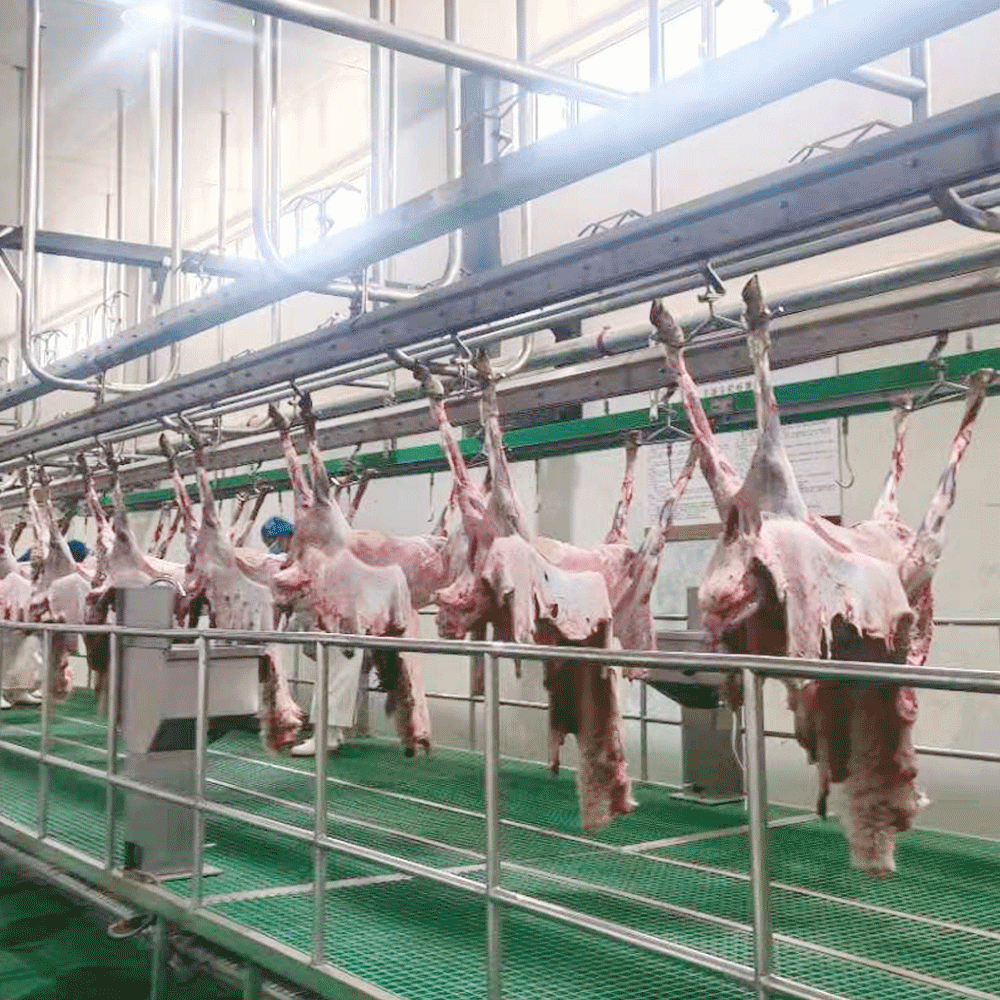
Three design strategies address this. First, parallel processing lanes: rather than a single linear slaughter rail, a dual-rail or V-type conveyor system allows two animals to advance simultaneously through bleeding and skinning stations, effectively doubling throughput without increasing line speed. Second, buffer zones between stations: strategic holding positions between stunning, bleeding, and evisceration allow workers to absorb short surges without rushing or compromising technique. Third, modular cold storage expansion: blast chillers and holding rooms should be sized for peak throughput, not average daily volume, since a carcass backlog at the chiller is one of the most common failure modes during Eid surges.
Processing Stages: Small-Carcass Ergonomics
Sheep and goat carcasses (typically 20–60 kg dressed weight) present distinct handling challenges compared to cattle or pig lines. The lighter weight is an advantage for manual handling, but the shorter carcass length means rail spacing, tool positioning, and operator reach distances should be calibrated differently. Standard cattle-grade overhead rails set at 2,400–2,600 mm height are excessive for sheep; rails at 1,800–2,200 mm better match operator ergonomics and reduce shoulder strain during repetitive skinning and evisceration tasks.
| Processing Stage | Key Equipment | Small-Carcass Consideration |
|---|---|---|
| Stunning | V-type conveyor, electrical tongs or captive bolt | Shorter conveyor width (350–400 mm); lower voltage settings for lamb |
| Bleeding | Overhead rail, blood collection trough | Hook spacing 600–800 mm vs 1,200 mm for cattle |
| Skinning / Pelting | Mechanical pelt puller, pneumatic skinning knife | Downward-pull pelters preferred; less force required reduces grain strain |
| Evisceration | Stainless steel evisceration table, offal conveyor | Table height 850–950 mm for optimal operator reach |
| Splitting | Band saw with narrow blade | Blade width 16–19 mm (vs 22–25 mm for cattle); lighter feed pressure |
| Chilling | Blast chiller, holding cold room | Faster core cooling due to lower mass; 4°C internal within 4–6 hours |
Breed variation further complicates ergonomic design. A 15 kg Boer goat kid and a 65 kg Merino wether processed on the same rail system require adjustable hook heights and variable-speed conveyors. Equipment that cannot accommodate this 4:1 weight ratio without manual intervention will create chronic inefficiencies outside the narrow mid-range for which it was originally specified.
Pelt Processing: Capturing By-Product Value
For many sheep and goat abattoirs, pelts represent the single largest non-meat revenue stream — yet they are routinely under-collected, poorly preserved, or discarded. The global sheep leather market was valued at over $21 billion in 2025 and is projected to reach nearly $30 billion by 2032 at a 4.88% CAGR. A single well-preserved sheepskin can retail for significantly more than the meat value from the same animal in certain premium markets, particularly for specialty wool breeds such as Merino, Shetland, and Karakul.
Mechanical pelt pullers produce measurably fewer downgraded pelts than manual knife skinning. The consistent downward pull and controlled rolling action reduce grain strain, blood spotting, and selvedge damage — the three primary causes of pelt downgrading that are difficult to avoid with hand-held knives.
Pelt Preservation Essentials
Pelt quality degrades rapidly after slaughter. Within 4–6 hours at ambient temperature, bacterial action begins to loosen wool follicles — a condition known as wool slip that renders the pelt worthless for leather or textile use. The preservation protocol is well-established but frequently neglected during peak-demand periods when staff are stretched:
- Immediate salting: Apply fine, non-iodized salt at 2–3 kg per sheepskin, working it thoroughly into all folds, leg openings, and tail areas. Salt draws moisture from the hide and inhibits bacterial growth.
- Second salting: After 24–48 hours, shake off the spent salt and apply a fresh layer. This second application ensures complete moisture extraction from thicker hide sections.
- Fleshing: Remove residual fat and meat tissue from the flesh side using a sharp fleshing knife or rotary fleshing machine. Leftover tissue will rot and prevent proper tanning agent penetration.
- Drying or cold storage: After curing, pelts should be dried on racks away from direct sunlight (7–30 days depending on climate) or held in cold storage at 2–4°C if being shipped to a tannery within one week.
Pelt Collection Infrastructure
Designing the kill floor for pelt recovery requires purpose-built collection points. Pelt chutes or conveyors positioned directly below each skinning station transport the pelt to a dedicated processing room without manual carrying — reducing both labor and contamination risk. In high-throughput lines (300+ head/hour), a dedicated pelt conveyor running parallel to the main slaughter rail collects pelts continuously and deposits them in the salting room. This infrastructure adds modest upfront cost and can be recovered over time through improved pelt grade revenue.
Capacity Planning: Four Operating Modes
Sheep slaughter lines serving markets with pronounced seasonal demand should be designed for four distinct operating modes rather than a single rated throughput:
| Operating Mode | Throughput Range | Typical Use Case | Key Equipment Needs |
|---|---|---|---|
| Standard Daily | 50–100 head/hour | Routine weekly processing | Single-rail line, manual skinning, basic chilling |
| Elevated Weekly | 100–200 head/hour | Pre-Ramadan stockpiling, export order fulfillment | Dual-rail or V-conveyor, one mechanical pelt puller, expanded offal handling |
| Peak Seasonal | 200–400 head/hour | Eid al-Adha (4–7 day window) | Parallel processing lanes, multiple pelt pullers, blast chiller at full capacity, additional holding pens |
| Surge Overflow | 300–500+ head/hour | Exceptional demand spikes, emergency regional supply | Fully automated line with redundant stations, extended shift staffing, backup refrigeration |
The transition between modes should be achievable through operational changes — adding shifts, activating parallel lanes, bringing seasonal workers on board — rather than requiring equipment reconfiguration. Modular rail extensions, plug-in stunning stations, and portable evisceration tables allow a line to scale up for a defined period and scale back down without permanent infrastructure commitments.
Industry Trends Shaping Sheep Slaughter in 2026
ASEAN halal processing expansion. Malaysia, Indonesia, and Thailand are investing heavily in domestic sheep and goat slaughter capacity to reduce dependence on Australian and New Zealand imports. This regional shift is creating demand for mid-capacity lines (100–300 head/hour) configured for both local consumption and regional export.
Pelt-as-revenue recognition. Processors who historically treated pelts as a disposal cost are now building dedicated pelt handling rooms, salting stations, and direct-to-tannery logistics. In several Middle Eastern markets, pelt revenue is increasingly recognized as a meaningful offset to slaughter operating costs rather than being treated as a disposal expense.
Smallholder aggregation models. In North and East Africa, cooperative slaughter facilities serving multiple smallholder producers are gaining traction. These facilities need flexible lines that can process mixed batches of sheep and goats with rapid species changeover — a capability not present in single-species industrial lines.
Water and energy efficiency in hot climates. Processing facilities in the Gulf and North Africa, where ambient temperatures exceed 40°C during Eid season, require cooling systems designed for extreme heat loads. Evaporative condenser pre-cooling, insulated holding pens, and high-efficiency blast chillers are becoming standard specifications rather than optional upgrades.
Halal audit digitization. Importing countries are increasingly requiring digital proof of halal compliance — time-stamped slaughter records, individual animal traceability, and auditor-verified process logs. Equipment control systems with integrated data logging are replacing hand-written ledgers for halal documentation.
Common Design and Purchasing Errors
1. Sizing for average, not peak. One of the most frequent errors in sheep slaughter line purchasing is specifying equipment for a facility's average daily throughput rather than its peak hourly requirement. A line that runs smoothly at 80 head/hour may collapse at 200 head/hour during Eid. The chiller, in particular, should be sized for peak — carcass spoilage from insufficient cooling capacity cannot be recovered.
2. Ignoring pelt collection infrastructure. Many abattoir designs treat pelt removal as a waste-disposal step rather than a value-recovery operation. Without dedicated pelt chutes, conveyors, and a salting room adjacent to the kill floor, pelts pile up on the floor, become contaminated, and lose 30–50% of their potential value before they ever leave the facility.
3. Single-rail bottleneck design. A single overhead rail with no parallel capacity means any station downtime — a dull blade change, a jammed pelt puller, a momentary hygiene intervention — stops the entire line. Dual-rail systems with cross-switching capability allow one lane to continue while the other is serviced.
4. Underestimating lairage requirements. During Eid periods, animals may arrive in large, irregular batches from multiple suppliers. A lairage designed for 4–6 hours of holding may need to accommodate 24–48 hours of inventory to manage supply volatility. Inadequate lairage means animals arriving at peak cannot be held under acceptable welfare conditions.
5. Treating halal compliance as an afterthought. Halal slaughter protocols affect physical equipment layout — separate lanes for religious-slaughter vs. stunned processing, dedicated knife sterilization stations, and auditor observation positions. Retrofitting these into a line not originally designed for halal operation is substantially more expensive than integrating them from the start.
Selecting a Sheep Slaughter Equipment Supplier
When evaluating suppliers for a seasonally-scalable sheep slaughter line, prioritize the following:
- Demonstrated multi-species capability: The supplier should have installations that process both sheep and goats, with documented changeover procedures. Single-species specialists may underestimate the adjustment range needed.
- Seasonal throughput references: Request case studies or customer references from facilities that operate with pronounced seasonal peaks. A line that performs well at steady-state 80 head/hour may not hold up at 250 head/hour in 40°C ambient conditions.
- Pelt system integration: The supplier should offer integrated pelt handling — not just a skinning machine, but a pelt collection, conveyance, and salting subsystem designed as part of the kill floor layout rather than a retrofit.
- Halal documentation support: Equipment control systems should generate audit-ready halal processing logs, and the supplier's engineering team should demonstrate familiarity with the documentation requirements of target export markets (GCC, ASEAN, EU).
- Modular expansion path: The line should be designed so that parallel lanes, additional stunning stations, and expanded chilling capacity can be added in phases without fundamentally re-engineering the facility layout.
Conclusion
Sheep and goat slaughter equipment should be designed for two very different realities: the steady, predictable throughput of routine weekly operation, and the intense, compressed demand window of Eid al-Adha and similar seasonal peaks. The difference between a line that handles both and one that fails during peak is not primarily about maximum-rated capacity — it is about modular scalability, parallel processing architecture, and the inclusion of value-recovery systems for pelts and by-products that justify the investment during off-peak months. Processors who plan for seasonal variability from the equipment specification stage, rather than reacting to it after installation, will be best positioned to serve their markets reliably, year after year.