Meat Cutting & Processing Line: Precision Technologies for Maximum Yield in 2026


Meat Cutting & Processing Line: Precision Technologies for Maximum Yield in 2026
The global meat processing industry is undergoing a significant transformation in 2026. With the meat and poultry processing equipment market valued at $15.5 billion in 2025 and expected to grow at a CAGR of 7% through 2035, processors are increasingly investing in precision cutting technologies that maximize meat yield while maintaining strict hygiene standards.
For meat processing facilities, the cutting and boning section is where profitability is truly determined. A difference of just 1–2% in meat yield can translate to tens of thousands of dollars in annual revenue for a medium-scale processor. This is why selecting the right meat cutting and processing line has become a critical strategic decision for processors worldwide.
The Evolution of Meat Cutting Technologies
Meat cutting has evolved from entirely manual operations to sophisticated processing lines that combine mechanical precision with ergonomic design. In 2026, the most successful processing facilities are those that have found the optimal balance between automation level, labor requirements, and capital investment.
Cutting Precision: The Foundation of Meat Yield
Cutting precision directly impacts meat yield — the percentage of saleable meat obtained from each carcass. Modern meat cutting lines employ several key technologies to maximize precision.
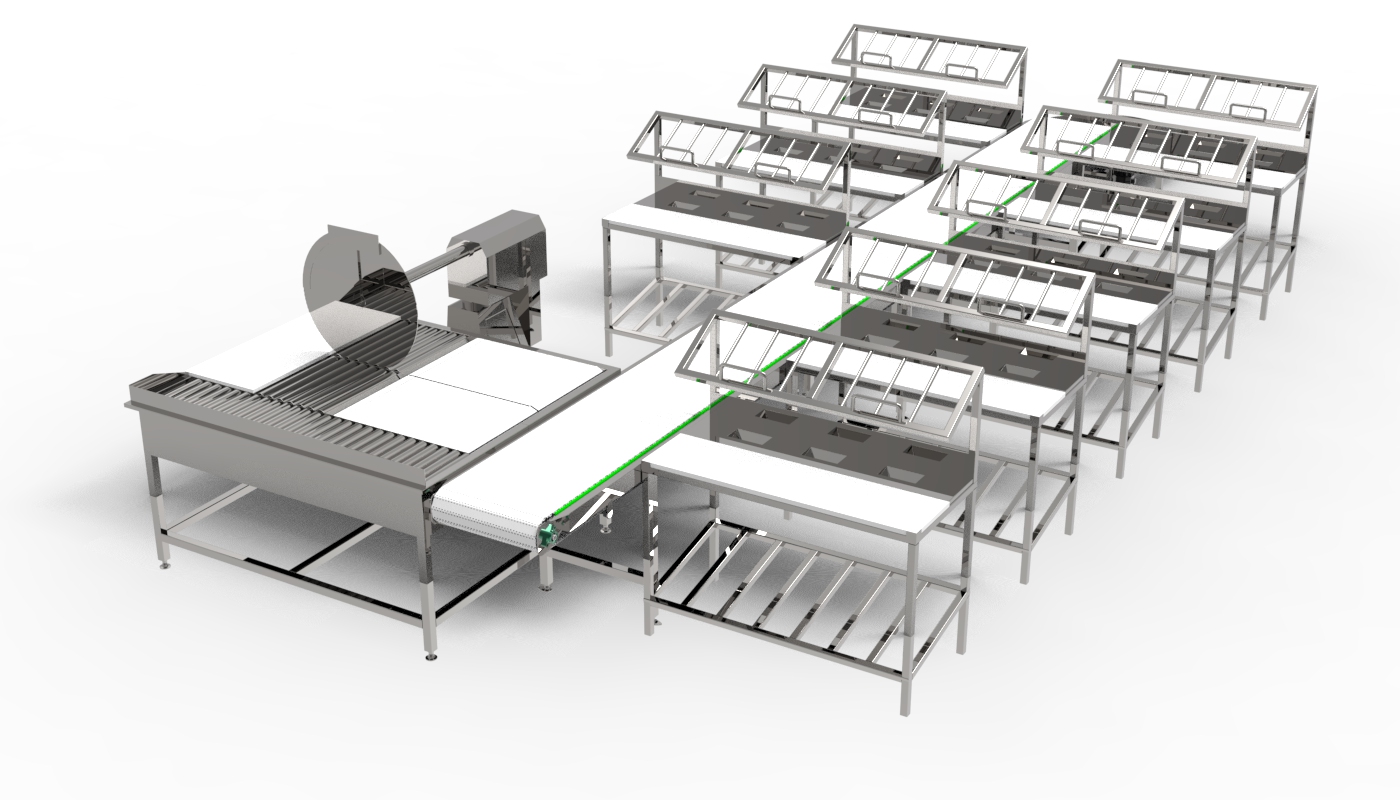
Band Saw Cutting Systems: The workhorse of meat cutting, modern band saw systems now feature variable speed controls and precision-guided cutting tables. For processors handling 500–2,000 kg/hour, semi-automated band saw stations with ergonomic positioning can achieve cutting tolerances within 2–3 mm, significantly reducing meat loss compared to manual cutting.
Rotary Blade Systems: For specific cutting applications such as portion control and steaking, rotary blade systems provide consistent slice thickness and reduced product deformation. These systems are particularly effective for poultry processing and prepared meat products.
Water-Jet Assisted Cutting: An emerging technology in high-end processing lines, water-jet assistance reduces blade friction and minimizes meat crushing during cutting. While still a premium option, it is gaining traction in facilities processing high-value cuts.
Deboning Technologies: Semi-automatic deboning workstations combine mechanical assistance with skilled manual operation, delivering 85–92% meat recovery rates at accessible price points.
Meat Yield Optimization Strategies
Maximizing meat yield is both an art and a science. The most effective processing lines incorporate several yield-optimization strategies.
1. Optimized Cutting Patterns
Modern processing lines use standardized cutting patterns based on carcass geometry. By training operators on precise cutting lines and using mechanical guides, facilities can achieve consistent yield improvements of 1.5–3% compared to freehand cutting.
2. Pre-Cutting Temperature Management
Meat temperature at the time of cutting significantly affects yield. Meat that is too warm is more difficult to cut precisely and experiences higher drip loss. The optimal cutting temperature range of 2–4 degrees C (35–39 degrees F) for most meat types should be maintained through controlled ambient temperatures in the cutting area.
3. Skilled Operator Training
Even the most advanced equipment requires skilled operators. Facilities with formal cutting skills training programs consistently outperform those without. A well-trained operator can achieve 2–4% higher yield than an untrained operator using identical equipment.
4. Equipment Maintenance and Blade Sharpness
Dull blades produce poor-quality cuts and actively reduce yield by crushing meat fibers and creating excessive trim loss. A proactive blade maintenance program, with blade changes scheduled based on cutting volume rather than visual inspection, is essential for maintaining optimal yield.
5. Integrated Meat Recovery Systems
Modern lines incorporate meat recovery systems that capture meat from bones after the primary cutting operation. Mechanical meat recovery units can extract an additional 0.5–1.5% of saleable meat from carcasses, providing a compelling return on investment for medium and large processors.
Hygiene Design: Non-Negotiable in 2026
Food safety regulations continue to tighten globally in 2026. Enhanced traceability requirements, combined with retailer-specific food safety standards, mean that hygiene design is no longer optional — it is a fundamental requirement for market access.
Key Hygiene Design Principles
Easy-to-Clean Surfaces: All equipment surfaces in contact with meat must be constructed from food-grade stainless steel (typically 304 or 316 grade) with surface roughness (Ra) not exceeding 0.8 micrometers. Welds should be ground smooth and passivated to prevent corrosion and bacterial adhesion.
CIP (Clean-in-Place) Compatibility: Modern cutting lines incorporate CIP-compatible design elements, including cleanable tunneling, spray balls for contact-surface cleaning, and sloped surfaces that eliminate standing water. Manually-assisted cleaning preparation can significantly reduce cleaning time and chemical consumption.
Tool-less Disassembly: Equipment that requires tools for disassembly takes longer to clean and is more likely to be improperly reassembled. Quick-release mechanisms, cam-lock connections, and tool-free belt removal are now standard expectations for new equipment.
Hygienic Conveyor Design: Conveyors in meat cutting areas must be designed to prevent bacterial growth. This means modular plastic belts or stainless steel mesh with accessible undersides, crowned pulleys to prevent belt tracking issues, and fully drainable frames.
Industry Trend 2026: The expansion of ready meal and premium pet food markets is creating demand for specialized cutting lines that can handle diverse product types and portion sizes. Processing lines capable of quick changeovers between product types are increasingly valued by processors serving multiple market segments.
Automation Tiers for Meat Cutting Lines in 2026
One of the most important decisions for processors is selecting the appropriate level of automation. The following framework presents four automation tiers, each suited to different operational scales and market positioning.
| Automation Tier | Throughput (kg/h) | Key Characteristics | Yield Expectation | Labor per Shift |
|---|---|---|---|---|
| Tier 1 — Basic Manual | 200–500 | Manual cutting, basic mechanical assistance, gravity conveyors | 78–82% | 8–12 operators |
| Tier 2 — Entry-Level Semi-Auto | 500–1,500 | Ergonomic cutting stations, mechanical guides, basic conveyor automation | 82–86% | 6–10 operators |
| Tier 3 — Moderate Automation | 1,500–3,000 | Automated conveying, pneumatic tools, semi-auto deboning, CIP-ready | 86–90% | 4–8 operators |
| Tier 4 — High Automation | 3,000–6,000+ | Auto portioning, mechanical deboning, traceability, full CIP, modular design | 88–92% | 3–6 operators |
Tier 4 represents the current capability ceiling for many Chinese manufacturers as of 2026. Fully robotic systems with AI-guided cutting remain in the domain of high-end European facilities.
Capacity Planning Reference
| Facility Scale | Throughput (kg/h) | Automation Tier | Space Required (m2) | Typical Payback Period |
|---|---|---|---|---|
| Small Abattoir | 200–500 | Tier 1 | 80–150 | 24–36 months |
| Medium-Small Processor | 500–1,500 | Tier 2 | 150–300 | 18–30 months |
| Medium Processor | 1,500–3,000 | Tier 3 | 300–500 | 18–24 months |
| Large Integrated Plant | 3,000–6,000+ | Tier 4 | 500–800 | 12–20 months |
2026 Industry Trends Impacting Meat Cutting
1. Accelerated Automation Adoption
Labor shortages in mature meat processing markets are driving accelerated adoption of semi-automated and moderately automated cutting systems. Equipment manufacturers are responding with automation levels that deliver meaningful labor savings without prohibitive price tags.
2. Single-Source Technology Providers Gain Preference
Food processors increasingly prefer sourcing complete lines from single providers rather than assembling lines from multiple equipment suppliers. The integration benefits — fewer compatibility issues, unified spare parts inventories, and streamlined technical support — are compelling. This trend favors equipment manufacturers that can provide end-to-end solutions spanning receiving, cutting, deboning, and packaging.
3. Hygiene Design as a Market Access Requirement
With food safety regulations expanding globally, hygiene design is no longer a differentiator — it is a market access requirement. Equipment that cannot demonstrate cleanability and material traceability faces exclusion from premium markets.
4. Modular Design for Product Flexibility
Market demands change rapidly. A line dedicated to a single product type can become a liability when consumer preferences shift. Prioritizing modular designs and quick-changeover capabilities preserves long-term flexibility and protects the equipment investment.
Five Common Mistakes in Meat Cutting Line Procurement
Mistake #1: Overestimating Automation Readiness
Many processors purchase high-automation equipment without having the technical staff to maintain it or the production volume to justify it. A thorough automation readiness assessment should precede any automation investment.
Mistake #2: Ignoring Meat Yield in TCO Calculations
The total cost of ownership for a meat cutting line extends far beyond the purchase price. Energy consumption, blade replacement costs, maintenance requirements, and — most importantly — meat yield impact should all be quantified. A line with 2% higher yield can pay for itself within 12–18 months for a medium-scale operation.
Mistake #3: Underestimating Hygiene Design Requirements
Equipment that seems affordable at purchase often becomes expensive when retrofits are needed to meet customer or regulatory hygiene standards. Verifying compliance with relevant sanitation standards before purchase prevents costly post-installation modifications.
Mistake #4: Neglecting Line Flexibility
Market demands change. Prioritizing modular designs and quick-changeover capabilities preserves long-term flexibility and protects the equipment investment.
Mistake #5: Inadequate Spare Parts and Training Planning
Even the best equipment underperforms without proper operator training and assured spare parts availability. Procurement decisions should evaluate the supplier's technical training offerings, spare parts lead times, and local technical support capacity.
Frequently Asked Questions
Q: What is the typical payback period for a semi-automated meat cutting line?
A: For medium-scale processors (1,500–3,000 kg/hour), the improved yield and labor savings typically deliver payback within 18–30 months.
Q: How much space is required for a 2,000 kg/hour cutting line?
A: Approximately 250–400 m2, depending on the level of automation and whether deboning is included in the same line.
Q: Can equipment handle halal/kosher processing requirements?
A: Yes, equipment can be specified with appropriate hygiene protocols, separate processing zones, and traceability systems to support halal and kosher certification requirements.
Q: What is the expected equipment lifespan of a well-maintained cutting line?
A: With proper maintenance, 10–15 years is typical. Stainless steel construction and proactive maintenance programs are key to achieving design lifespan.
Q: How important is temperature control during cutting operations?
A: Very important. Meat cut at 2–4 degrees C experiences less deformation, cleaner cuts, and reduced drip loss compared to meat cut at higher temperatures.
Conclusion
Selecting a meat cutting and processing line is a decision that will influence operational profitability for 10–15 years. The most successful processors in 2026 are those that match automation level to their actual operational needs, prioritize meat yield optimization, and insist on hygiene design that meets both current and anticipated regulatory requirements.
At SD Henger Group, we design and manufacture meat cutting and processing lines that balance precision, yield, and hygiene — engineered for the practical realities of modern meat processing facilities. Our equipment is trusted by processors across 100+ countries, from small abattoirs to large integrated meat processors.
Whether you are upgrading an existing cutting line or building a new processing facility, our team can help you select the automation tier and configuration that aligns with your production volume, labor resources, and market requirements.
Contact SD Henger Group today to discuss your meat cutting line requirements. Our technical team will work with you to design a solution that maximizes your meat yield and meets your hygiene compliance needs.