Poultry Slaughter Equipment: A Complete Buyer's Guide for Modern Processing Plants 2026


Poultry Slaughter Equipment: A Complete Buyer's Guide for Modern Processing Plants 2026
Every poultry processing operation starts with the same question: what does a complete slaughter line actually look like, and where do I even begin evaluating equipment? The answer has gotten more complex in 2026 — not because the biology of a chicken has changed, but because the range of available technology, regulatory pressures, and market expectations have expanded dramatically.
The global poultry processing equipment market is valued at USD 3.93 billion in 2026, projected to reach USD 5.62 billion by 2035 at a CAGR of 4.1% (Business Research Insights). The broader meat and poultry processing equipment market hit USD 15.5 billion in 2025 with 7% annual growth through 2035 (GMI Insights). That growth is being driven by rising global protein consumption, stricter food safety regulations, and an accelerating shift toward mechanized processing lines — particularly in regions where labor shortages are making manual operations increasingly untenable.
This guide breaks down the full poultry slaughter process, the equipment options available at each stage, and the key decision factors every processor should weigh in 2026.
Why Modernization Is No Longer Optional
Five years ago, a small-to-medium poultry processor could get by with a largely manual line and compete on price. That window is closing. Labor costs have risen substantially across Southeast Asia, Sub-Saharan Africa, and parts of Latin America — the very regions driving the biggest increases in poultry consumption. At the same time, export markets are tightening their biosecurity and animal welfare requirements.
Modern poultry slaughter equipment doesn't just increase throughput. It delivers three things that matter in 2026: consistent product quality, verifiable food safety compliance, and the documentation trail that export markets increasingly demand.
"Equipment choices made today will define a plant's competitive position for the next decade. Investing in the right line is not a cost — it's a strategic decision." — Industry analyst, Poultry Processing & Packaging Market Report 2026
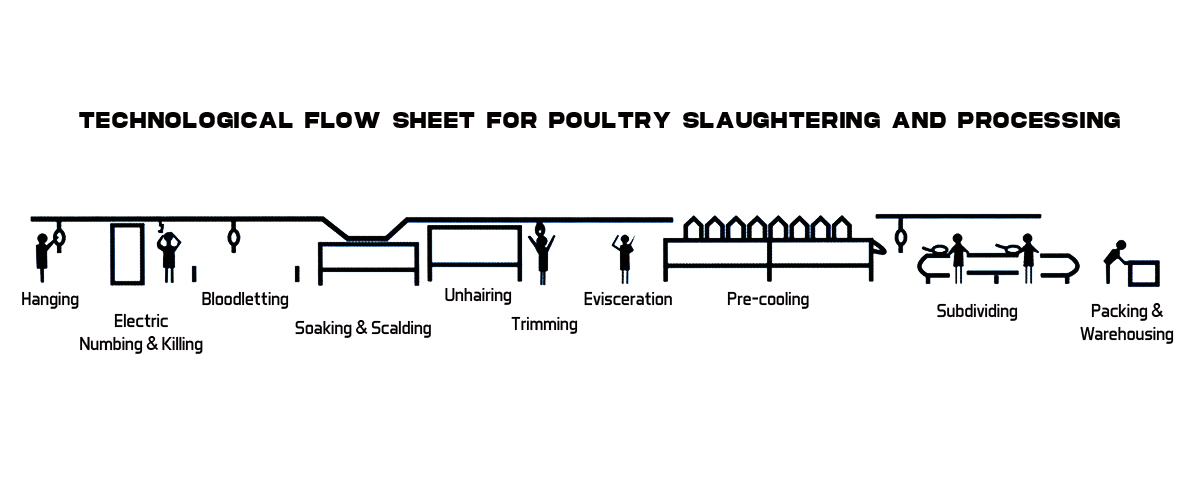
The 7 Stages of a Modern Poultry Slaughter Line
Stage 1: Receiving and Live Bird Handling
The process begins the moment birds arrive at the facility. Live bird handling systems include receiving crates, weighing stations, and animal welfare assessment points. Well-designed receiving areas minimize stress on birds before stunning, which directly affects meat quality and dressing percentage. Modular lairage systems allow processors to manage variable batch sizes while maintaining welfare compliance under halal or general slaughter standards.
Stage 2: Stunning
Stunning renders birds unconscious before slaughter, ensuring welfare compliance and operator safety. The two dominant technologies in 2026 are:
Electrical stunning: Immersion or head-only systems deliver controlled current to induce instant unconsciousness. Widely used in conventional and some halal operations. Requires careful calibration to avoid bone damage or bloodsplashing.
Controlled Atmosphere Stunning (CAS): Uses atmospheric gas (CO₂ or inert gas mixtures) to induce a stress-free loss of consciousness. Produces superior meat quality with reduced bone breakage and better visual appearance. Higher capital cost but growing adoption in high-volume plants.
For processors targeting halal certification, stunning method must be documented and approved by the relevant halal authority — CAS is increasingly accepted by major halal certification bodies in Southeast Asia and the Middle East.
Stage 3: Bleeding
After stunning, birds are conveyed to bleeding tunnels or stations. The bleeding process typically takes 90–180 seconds for effective exsanguination. Automated bleeding conveyor systems maintain consistent throughput and reduce labor requirements. Proper bleeding time is critical — insufficient bleeding leads to reduced shelf life and compromised visual quality of the carcass.
Stage 4: Scalding
Scalding loosens feathers by immersing carcasses in hot water at controlled temperatures. Temperature selection depends on the end product:
Soft scald (58–60°C): Preserves skin integrity and is preferred for whole bird markets where appearance matters. Common in Asia and parts of Europe.
Semi-scald / parchment scald (60–63°C): Compromise between skin quality and plucking ease.
Hard scald (68–72°C): Maximizes plucking efficiency but damages skin. Primarily used for further-processed bird products.
Automated scald tanks with recirculation systems maintain consistent temperature and reduce water consumption compared to batch systems.
Stage 5: Feather Removal (Plucking)
Modern plucking systems use soft rubber fingers mounted on rotating discs or drums. The transition from batch pickers to inline drum pluckers has been one of the most significant productivity advances in poultry processing.
Key parameters include finger hardness, drum rotation speed, and bird throughput rate. A properly calibrated inline plucker achieves 95–98% feather removal in a single pass, dramatically reducing the need for manual finishing.
Stage 6: Evisceration
Evisceration — removal of internal organs — is the most technically demanding stage of the slaughter line. Automated evisceration systems use mechanical or pneumatic mechanisms to extract viscera while minimizing carcass damage. The process must maintain hilal integrity for halal lines (where intestinal contact with the carcass is prohibited) and meet stringent hygiene requirements for all markets.
Automated eviscerators handle birds at rates from 500 to over 10,000 birds per hour depending on the system. Manual or semi-automatic stations remain common in smaller facilities but face increasing scrutiny on food safety grounds.
Stage 7: Chilling and Grading
Post-evisceration carcasses must be chilled rapidly to inhibit bacterial growth. The two primary chilling methods are:
Air chilling: Carcasses are chilled in controlled-temperature chambers with cold air circulation. Produces drier skin (preferred in some markets) and avoids water absorption. Higher energy cost but better shelf life and product quality.
Immersion chilling: Carcasses are submerged in chilled water or ice-water slugs. More efficient thermally and widely used in high-volume conventional processing. Water absorption limits are regulated in many markets.
After chilling, carcasses move through grading stations where weight, visual appearance, and compliance checks are recorded. Automated grading systems with conveyor-integrated weighing and inspection points are increasingly standard in plants targeting 2,000+ birds per hour.
Capacity Tiers: Matching Equipment to Your Operation
Capacity Tier | Hourly Throughput | Recommended Configuration | Best For |
|---|---|---|---|
Tier 1 — Entry | 200–1,000 bph | Semi-automatic line; manual evisceration stations; batch scalder; single-stage plucker | Small commercial abattoirs, regional processors, startup operations |
Tier 2 — Mid-Scale | 1,000–3,000 bph | Inline conveyor; continuous scalder; multi-stage drum plucker; semi-automatic evisceration; air or immersion chilling | Medium processors, food service suppliers, regional export operations |
Tier 3 — Industrial | 3,000–6,000 bph | Fully inline automated line; CAS or electric stunning; automatic evisceration; air chilling with integrated grading; full CIP cleaning | Large commercial plants, national supply chain, halal-certified processors |
Tier 4 — High-Volume Export | 6,000+ bph | Advanced automation; multi-lane inline system; vision inspection; digital traceability; full HACCP integration | Major exporters, integrated poultry producers, multinational operations |
Halal Compliance: A Non-Negotiable for Many Markets
For processors targeting Muslim-majority markets — Southeast Asia, the Middle East, Africa — halal certification is a baseline requirement, not a differentiator. In 2026, halal poultry requirements extend beyond just the stunning method to encompass the entire slaughter process, including:
Stunning parameters approved by the relevant halal authority
Continuous documentation of each batch through the line
Segregation of halal and non-halal products at every stage
Traceability from farm of origin to packaged product
Specific requirements for water used in processing (potability certification)
Equipment configuration for halal lines typically requires dedicated lines or validated changeover procedures, dedicated stunning systems, halal-compliant water supply, and integrated traceability systems that can generate audit-ready documentation for every shift.
5 Common Equipment Selection Mistakes
Mistake 1: Buying Capacity You Cannot Fill
High-capacity lines are expensive to run at partial load. Select equipment that matches your realistic current and projected throughput for at least three years — not the peak demand you hope to reach.
Mistake 2: Ignoring Water and Energy Infrastructure
A plant that undersizes its water treatment or refrigeration systems will spend years managing bottlenecks that the equipment supplier never warned about. Map your utility requirements before finalizing equipment specifications.
Mistake 3: Skipping the Scalding Temperature Audit
Many processors underestimate how much scald temperature affects their finished product quality and market reach. Lock in your target market's requirements before choosing scald equipment — retrofitting is expensive.
Mistake 4: Treating Evisceration as a Labor Problem Only
Labor savings drive the ROI case for automatic eviscerators, but the bigger value is food safety consistency. Manual evisceration introduces variability in hygiene standards that increases spoilage risk and customer returns. Evaluate evisceration equipment on both metrics.
Mistake 5: No Traceability Architecture from Day One
Traceability requirements from export markets — and increasingly from domestic retail — require data collection at every stage. Equipment purchased without integration capability creates expensive retrofit problems later.
2026 Market Outlook: What to Watch
Three macro trends are reshaping poultry slaughter equipment decisions in 2026:
1. AI-assisted quality inspection: Vision systems using trained neural networks are beginning to appear in mid-scale poultry processing for defect detection, fecal contamination screening, and carcass grading. While full integration remains a Tier 4 application, processors should ensure new equipment purchases are compatible with future inspection system retrofits.
2. Natural refrigerants and energy efficiency: Rising energy costs and environmental regulations are pushing chillers and refrigeration systems toward CO₂ (R744) and ammonia-based solutions. New plant specifications should prioritize energy efficiency ratings as a lifecycle cost factor, not just capital price.
3. Modular lines for emerging markets: Processors in high-growth markets — particularly Sub-Saharan Africa, Southeast Asia, and Central Asia — are increasingly favoring modular slaughter line designs that can expand in phases. This approach reduces upfront capital risk while maintaining upgrade paths to higher automation.
Frequently Asked Questions
Q: What is the minimum capacity for an economically viable poultry slaughter line?
A: Most industry sources suggest 1,000–2,000 birds per hour as the threshold where automation starts delivering clear ROI over manual operations in terms of labor savings, consistency, and food safety compliance.
Q: Can one line handle both broilers and spent laying hens?
A: Some equipment manufacturers offer adjustable plucking and hanging systems, but in practice, the size and conformation differences between broilers and spent hens often require dedicated equipment configurations.
Q: How long does it take to commission a new poultry slaughter line?
A: A Tier 2 semi-automatic line typically requires 3–6 months from order to commissioning. A full Tier 3 industrial line can take 12–18 months including facility construction.
Q: What is the difference between CAS and electrical stunning for halal certification?
A: CAS (Controlled Atmosphere Stunning) using inert gases is accepted by a growing number of halal certification bodies as it induces unconsciousness without pain. Electrical stunning is accepted by some authorities but rejected by others depending on parameters and certification body. Always confirm with your specific halal certification authority before specifying equipment.
Q: How do I ensure my equipment meets export market requirements?
A: Identify your target market's specific requirements (temperature, traceability, halal, welfare standards), then work backward to specify equipment that generates the required documentation and meets the technical parameters. A reputable equipment supplier with international experience should guide this process.
Ready to Explore Your Poultry Slaughter Equipment Options?
SD Henger Group designs and manufactures complete poultry slaughter lines tailored to your capacity, market requirements, and expansion roadmap. Our equipment covers the full processing flow from live bird receiving to chilled carcass output, with configurations for both conventional and halal-certified operations.
Whether you are commissioning a new facility or upgrading an existing line, our engineering team can provide equipment specifications, factory layout recommendations, and commissioning support.
Contact us today to discuss your project requirements and receive a customized equipment proposal.