Sheep & Goat Slaughter Equipment: The Complete Buyer's Guide for Modern Processing Facilities in 2026


Sheep & Goat Slaughter Equipment: The Complete Buyer's Guide for Modern Processing Facilities in 2026
The global sheep and goat meat market is undergoing a structural transformation. With production volumes expanding across the Middle East, Africa, South Asia, and Oceania, processors are under mounting pressure to upgrade their equipment—not just to boost throughput, but to meet increasingly strict halal compliance requirements, animal welfare standards, and labor cost realities that manual operations simply cannot address anymore.
For processors planning a new facility or upgrading an existing one, the question is not whether to invest in modern sheep and goat slaughter equipment, but how to choose the right configuration without overbuilding or underperforming. This guide breaks down everything you need to know before signing a purchase order.
Understanding the Sheep & Goat Slaughter Equipment Market in 2026
The sheep and goat equipment market reached approximately USD 3.2–3.4 billion in 2024–2025, with projections indicating growth to USD 5.4 billion by 2035 at a compound annual growth rate (CAGR) of 4.8%. This growth is driven by three converging forces: rising labor costs in traditional sheep-rearing regions, expanding middle-class demand for halal-certified protein in MENA and Southeast Asia, and tightening regulations around animal welfare and food traceability.
For equipment buyers, this means two things: first, competition among manufacturers is intensifying, creating both opportunity and confusion; second, the risk of purchasing outdated or underperforming equipment has never been higher. A slaughter line that cannot adapt to halal certification requirements or handle the specific carcass dimensions of local breeds will become a liability within a few years of operation.
The slaughtering equipment market overall is projected to expand from USD 4.25 billion in 2024 to USD 6.78 billion by 2033, with sheep and goat applications representing a growing share of this total. Understanding where your facility fits within this broader trend is the first step in making a sound investment decision.
The 8-Stage Sheep & Goat Slaughter Process: What Equipment Each Step Requires
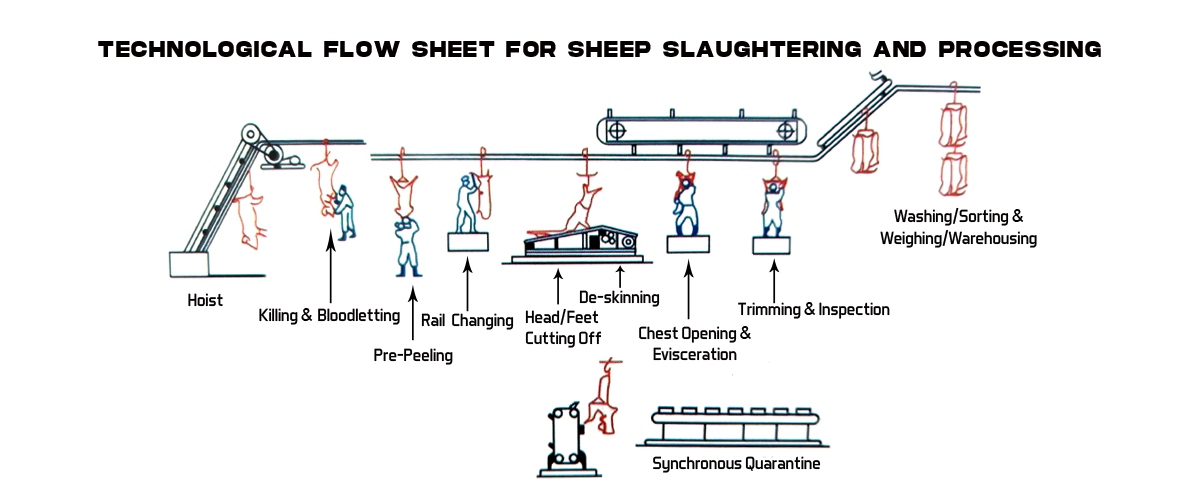
A modern sheep and goat slaughter line comprises eight core stages, each demanding specific equipment considerations. Getting any single stage wrong can compromise the entire line's efficiency, product quality, or compliance status.
Stage 1: Reception and Lairage
Before animals enter the slaughter line, they spend time in lairage — a holding area where they are rested, watered, and assessed for fitness. Overcrowding or poor lairage design causes stress that degrades meat quality. Equipment needs include low-stress unloading ramps, anti-slip flooring, individual pen dividers, and water喂 stations. For operations processing multiple species, species-specific holding pens prevent cross-contamination and animal distress.
Stage 2: Stunning
Stunning renders animals unconscious before bleeding, which is both an animal welfare requirement under most international standards and a quality control measure. For sheep and goats, two stunning methods dominate the market:
| Stunning Method | Best For | Key Consideration |
|---|---|---|
| Captive Bolt Stunning | Mid-to-large operations; religious slaughter lines | Requires precise positioning; effective for both sheep and goat carcasses |
| Electrical Stunning | Smaller operations; Halal-certified lines | Lower cost; requires correct voltage and electrode placement |
| Gas Stunning (CO₂) | High-capacity poultry and pig operations | Less common for sheep/goats; unsuitable for small ruminants |
For Halal-certified operations, stunning parameters must be documented and verified by the certifying body. The stunning device must not kill the animal before bleeding — this is a critical compliance distinction that many buyers overlook.
Stage 3: Bleeding
After stunning, animals are bled using a chest stick or jugular cut method. For halal compliance, the cut must be made by a trained Muslim slaughterer immediately after stunning. Equipment options include automated bleeding conveyors with rotating hooks that position the carcass optimally, or manual bleeding rails for lower-throughput operations. Blood collection systems should direct blood away from the carcass to prevent contamination.
Stage 4: Skinning (Fleecing)
Sheep and goat carcasses are typically skinned using a combination of mechanical aides and manual technique. For sheep with intact wool, a wool-pulling machine or fleshing machine preps the hide for removal. For goats and shorn sheep, mechanical skinning arms and overhead rail systems reduce manual labor. The key equipment decision here involves choosing between V-shaped rotating skinning lines — which allow one operator to work both sides of the carcass — and traditional hanging skinning rails.
Stage 5: Evisceration
Evisceration — the removal of internal organs — is one of the most hygiene-critical stages. Equipment considerations include ergonomic evisceration tables with built-in organ separation trays, automated bung removal tools, and carcass splitting saws. For halal compliance, the liver, lungs, and heart must be inspected by an authorized inspector before the carcass proceeds. Maintaining a continuous flow evisceration line prevents cross-contamination between carcasses.
Stage 6: Carcass Splitting and Trimming
After evisceration, the carcass is split into two halves using a bandsaw or carcass splitting machine, then trimmed to remove blemishes, bruises, or remaining fat deposits. For goat carcasses, which are smaller than sheep, adjustable splitting guides prevent over-splitting. Automated trimming stations with stainless steel work surfaces and integrated carcass rail systems improve throughput significantly compared to static work tables.
Stage 7: Grading and Classification
Carcass grading — assessing yield, fat cover, and conformation — determines commercial value. Visual grading remains the most common method in sheep and goat processing, though automated grading technologies using camera-based systems are emerging in high-capacity facilities. Grading stations should be well-lit and positioned at the end of the main slaughter line before chilling.
Stage 8: Chilling and Cold Storage
After grading, carcasses enter the chiller to reduce core temperature to below 7°C within 24 hours. This is both a food safety requirement and a quality preservation measure. Blast chillers capable of reducing carcass temperature rapidly to 0–3°C are preferred for high-throughput operations, while conventional chillers suffice for smaller facilities. Chilling capacity must match slaughter line throughput — undersized chillers create bottlenecks that compromise product quality and food safety.
Halal Compliance: Configuring Your Sheep Slaughter Line for Islamic Markets
For processors targeting MENA, Southeast Asian, or South Asian markets, halal certification is not optional — it is a market access requirement. Configuring a sheep or goat slaughter line for halal compliance involves more than simply adding a Muslim slaughterer. It requires a holistic approach to equipment, process design, and documentation.
Key halal compliance configuration points include:
- Dedicated halal slaughter rails: Physically separating halal and non-halal lines during the bleeding stage prevents cross-contamination of product.
- Documented stunning parameters: Stunning voltage, captive bolt penetration depth, and recovery time must be recorded and verified.
- Trained Islamic slaughter personnel: The slaughterer must hold a recognized halal slaughter certification, and the knife cut must sever both jugular veins and the windpipe in a single continuous motion.
- Traceability systems: Each carcass must carry lot-level traceability from stunning to final packaging, enabling recall capability.
- Halal-certified ancillary materials: Lubricants, cleaning agents, and packaging materials used in halal-certified facilities must themselves carry halal certification.
The Middle East and North Africa region continues to be the largest market for sheep meat globally, while Southeast Asia — particularly ASEAN countries — is emerging as a high-growth halal market amid geopolitical shifts in traditional Middle Eastern trade corridors. Processors with properly configured halal lines are well-positioned to capture this demand growth.
Production Capacity Reference: Choosing the Right Throughput Tier
| Capacity Tier | Throughput (heads/hour) | Recommended Configuration | Typical Buyer Profile |
|---|---|---|---|
| Entry-Level | 20–50 | Manual rail + basic stunning equipment; manual evisceration; conventional chiller | Small community abattoirs; emerging market startups |
| Mid-Range | 100–300 | Semi-mechanized rail; electrical stunning; evisceration tables; blast chiller | Regional processors; export-oriented facilities |
| High-Capacity | 500–1,000+ | Fully mechanized lines; automated stunning; continuous evisceration; real-time grading; blast chilling | Industrial-scale processors; integrated protein companies |
Overcapacity is a common mistake. Buyers frequently purchase equipment rated above their actual throughput needs, resulting in underutilized capital assets and higher maintenance costs. Conversely, underestimating capacity growth — particularly for facilities serving expanding export markets — forces costly premature upgrades within 3–5 years of commissioning.
5 Common Procurement Mistakes and How to Avoid Them
1. Prioritizing Equipment Price Over Total Cost of Ownership
The lowest-priced sheep slaughter line often carries the highest long-term cost. Wear parts availability, energy efficiency, sanitation accessibility, and manufacturer service response times all affect total cost of ownership significantly. Always request total cost of ownership (TCO) projections covering at least 5 years of operation.
2. Ignoring Local Breed Characteristics
Sheep and goat breeds vary substantially in carcass size, fat distribution, and bone structure. Equipment calibrated for European breeds may not perform optimally for Dorper, Merino, or local hair goat breeds common in Africa and Asia. Confirm that equipment specifications — particularly skinner arm settings, evisceration table dimensions, and splitting guide adjustments — are compatible with your target breeds.
3. Skipping the Layout and Workflow Simulation
Many buyers order equipment without simulating the physical layout of their processing hall. A slaughter line that looks efficient on paper can create severe bottlenecks if the spatial relationships between stages are wrong. Request a 2D or 3D layout drawing from your supplier before finalizing your order, including clearance requirements for equipment maintenance and sanitation access.
4. Underestimating Hygiene and Sanitation Requirements
Food safety regulations — including HACCP, ISO 22000, and halal certification standards — impose strict requirements on equipment surface finishes, drainage design, and cleaning accessibility. Equipment with dead zones, crevices, or inaccessible surfaces will fail hygiene audits and create food safety risks. All product-contact surfaces must be 304 stainless steel with a smooth Ra ≤ 1.6 µm finish.
5. Not Planning for Scalability
Your facility's throughput requirements today are unlikely to be the same in 5 years. Choose equipment lines that allow incremental capacity expansion — modular rail sections, additional stunning stations, or parallel evisceration lanes — rather than single-purpose configurations that require complete replacement to scale.
Industry Trends Shaping Sheep & Goat Slaughter Equipment in 2026
Several macro-level trends are reshaping how processors evaluate and invest in sheep and goat slaughter equipment this year:
Halal market expansion into ASEAN. As geopolitical dynamics shift in traditional Middle Eastern trade corridors, Southeast Asian nations — particularly Malaysia, Indonesia, and Thailand — are emerging as both major consumers and growing producers of halal-certified sheep and goat meat. This is creating demand for new processing facilities across the region.
Labor cost pressures accelerating automation. The availability of skilled slaughter labor is declining in most producing regions, driving adoption of semi-mechanized and fully mechanized sheep slaughter lines even among mid-sized processors who previously relied on manual labor.
Traceability mandates tightening. Importing countries — particularly in the EU and Southeast Asia — are implementing stricter carcass-level traceability requirements, favoring processors with integrated digital tracking systems from stunning through packaging.
Modular plant designs gaining traction. Pre-configured, modular slaughter line sections that can be assembled in weeks rather than the months required for traditional civil-construction-based abattoirs are opening market access for smaller regional processors.
Frequently Asked Questions
What is the minimum space requirement for a sheep and goat slaughter line?
An entry-level line (20–50 heads/hour) can operate in approximately 200–400 square meters of dedicated processing space. Mid-range operations (100–300 heads/hour) typically require 500–1,000 square meters including chilling and ancillary areas.
Can the same equipment process both sheep and goats?
Yes, with appropriate adjustments. Goats are smaller and have different carcass proportions than sheep, so skinner arm settings, splitting guide positions, and evisceration table dimensions must be calibrated for each species. Equipment manufacturers can provide dual-species configuration specifications.
What certifications should I require from a sheep slaughter equipment supplier?
At minimum: CE marking (for equipment sold in Europe and many export markets), ISO 9001 quality management certification, and relevant food machinery hygiene certifications. For halal market access, the supplier should be able to provide equipment documentation compatible with halal audit requirements.
How long does it take to commission a new sheep and goat slaughter line?
Equipment installation and commissioning typically takes 4–12 weeks depending on the level of mechanization and site preparation requirements. Full halal certification audit may add an additional 4–8 weeks.
What maintenance requirements should I budget for?
Budget 2–4% of equipment purchase value annually for scheduled maintenance, including blade sharpening or replacement (splitting saws and skinning knives), rail alignment checks, stunning device calibration, and stainless steel surface passivation. Unscheduled breakdowns can add 1–2% additional cost.
Conclusion: Making the Right Equipment Decision for Your Facility
Investing in sheep and goat slaughter equipment is a decision that shapes your facility's operational efficiency, compliance status, and market competitiveness for years to come. The equipment landscape in 2026 offers more choices than ever, but quality and suitability vary widely across manufacturers.
Whether you are processing 50 heads per day for a regional market or 1,000 heads per day for export, the principles remain the same: match equipment specifications to your actual species requirements, plan for halal compliance from day one if you are targeting Islamic markets, and always evaluate total cost of ownership rather than purchase price alone.
SD Henger Group designs and manufactures sheep and goat slaughter equipment for processors in over 100 countries. Our engineering team works with each customer to configure production lines matched to their species mix, throughput requirements, and market destination — including full halal compliance documentation support.
Ready to Configure Your Sheep & Goat Slaughter Line?
Contact our engineering team for a customized equipment proposal tailored to your capacity, species, and market requirements.