The State of Cattle Slaughter Equipment in 2026
The global cattle slaughter equipment market has reached a defining moment. Valued at approximately USD 1.2 billion in 2024, the market is on track to surpass USD 2.5 billion by 2034, growing at a compound annual growth rate of 7.8%. This expansion is not simply about more equipment being sold — it reflects a fundamental shift in how beef is produced, processed, and delivered to markets around the world.
Three forces are reshaping cattle slaughter operations globally. First, beef consumption continues its steady climb, with the FAO projecting global demand to reach approximately 60 million tonnes by 2034. Second, regulatory frameworks for animal welfare and food safety are tightening across every major market — from the EU's comprehensive welfare regulations to the USDA's updated standards in North America and Halal compliance requirements across the Middle East and Southeast Asia. Third, labor shortages in meat processing facilities are accelerating the adoption of mechanized and semi-automated systems, particularly in regions that previously relied heavily on manual operations.
For facility managers, procurement officers, and project developers planning new cattle slaughter operations — or upgrading existing ones — understanding these shifts is essential. This guide provides a practical, stage-by-stage overview of a complete cattle slaughter line, along with clear benchmarks for equipment selection.
The Eight Stages of a Cattle Slaughter Line
A modern cattle slaughter line consists of eight principal stages, each requiring specialized equipment designed for efficiency, hygiene, and compliance with animal welfare standards.
Stage 1: Receiving and Lairage
The process begins well before any processing takes place. Cattle arriving at a slaughter facility need proper receiving infrastructure and a well-managed lairage (holding area) system. Effective lairage design directly impacts both animal welfare outcomes and final meat quality — stressed cattle produce higher pH meat with reduced shelf life and tenderness.
Key equipment for this stage includes:
- Crowding gates and race systems — designed to move cattle calmly and efficiently toward the processing area without excessive force
- Anti-slip flooring — grooved concrete or rubberized surfaces that reduce slipping and injury
- Watering and feeding systems — automatic troughs that maintain hydration during the holding period
- Shade structures and ventilation — particularly important in tropical and subtropical climates
- Weighing scales — integrated into the race for accurate liveweight recording
Stage 2: Restraint and Stunning
The restraint and stunning stage is arguably the most critical from both welfare and compliance perspectives. Proper stunning ensures the animal is insensible to pain before processing begins, which is not only an ethical requirement but also a legal one in virtually every major market.
| Stunning Method | How It Works | Typical Application |
|---|---|---|
| Captive bolt (penetrating) | Fires a retractable bolt into the brain, causing immediate unconsciousness | Most common globally; suitable for high-throughput facilities |
| Captive bolt (non-penetrating) | Delivers a strong impact to the skull without penetrating | Used in some religious slaughter contexts |
| Electrical stunning | Passes electric current through the brain to induce insensibility | Common in some regions; requires precise current control |
Equipment considerations include box-type or conveyorized restraint systems, pneumatic or cartridge-fired captive bolt guns, and stun-to-stick intervals of 10 to 15 seconds maximum.
Stage 3: Bleeding (Exsanguination)
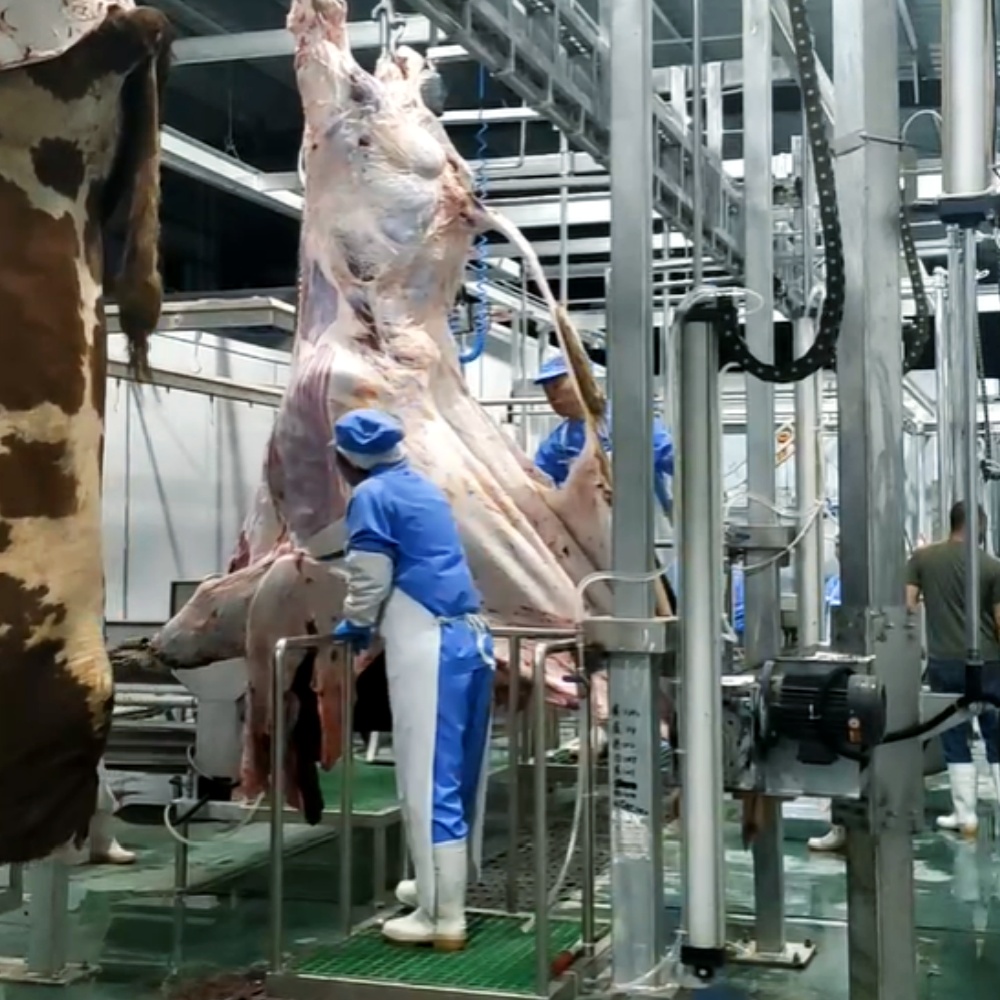
After stunning, cattle are raised via a hoist or tilt table, and the major blood vessels in the neck are cut. Essential equipment includes hydraulic or mechanical hoists (rated for 300 to 700 kg liveweight), overhead bleeding rails, and blood collection systems for by-product processing. A minimum of 4 to 6 minutes of bleeding time is standard.
Stage 4: Hide Removal
Hide removal is one of the more technically demanding stages in cattle processing. The hide must be removed cleanly without puncturing the underlying tissue, which would introduce contamination. Semi-mechanized hide removal involves a sequence of cuts followed by mechanical pulling, while automated systems use rollers, chains, and hydraulic mechanisms for more controlled removal.
Key equipment includes down-pull or up-pull hide pullers, hide roller systems, hand tools with safety gear, and hide washing and handling systems.
Stage 5: Head Removal and Inspection
After hide removal, the head is separated for veterinary inspection. This is mandatory in most jurisdictions for disease surveillance, particularly for BSE. Equipment includes head droppers or splitters, head washing stations, identification systems (ear tag readers or RFID), and inspection stations with proper lighting.
Stage 6: Evisceration
Evisceration involves the removal of all internal organs. This stage requires extreme care to prevent contamination from intestinal contents. The standard sequence includes opening the abdominal cavity, freeing the digestive tract, removing the pluck set (heart, lungs, liver, trachea), kidney removal, and cavity washing.
Equipment includes evisceration tables or platforms, carcass splitting saws, intestinal washing systems, and offal handling conveyors.
Stage 7: Carcass Splitting and Trimming
After evisceration, the carcass is split into two sides along the vertebral column using a mechanical splitting saw (circular or band saw). This stage also includes spinal cord removal for SRM compliance in some markets, trimming stations with knife sterilizers, and carcass rail systems for transporting split sides to chillers.
Stage 8: Chilling and Cold Storage
The final stage involves two-phase chilling: rapid chilling (37°C to 7°C within 18 to 24 hours) followed by aging (7 to 14 days at controlled temperatures for natural tenderization). Equipment includes blast chillers with forced-air circulation, hanging rails with adequate spacing, temperature monitoring systems with data loggers, and cold storage rooms.
Equipment Configuration by Throughput Level
| Throughput Level | Head per Shift | Typical Equipment Configuration |
|---|---|---|
| Small-scale | 10–30 | Manual restraint, cartridge-fired captive bolt, manual hide pulling, single-rail hanging system, walk-in chiller |
| Mid-scale | 30–100 | Box-type restraint, pneumatic captive bolt, semi-mechanized hide puller, double-rail system, mechanical splitting saw, blast chiller |
| Large-scale | 100–300+ | Conveyorized restraint, automated captive bolt systems, automated hide pulling, continuous rail, fully integrated chilling tunnels |
Four Automation Levels Explained
Level 1: Manual Operation
All processes are performed by skilled operators using hand tools. This level is typical of very small rural abattoirs and is common in developing markets, with throughput limited to under 15 head per shift.
Level 2: Semi-Mechanized
Operators perform most tasks manually but use mechanical aids for physically demanding operations: hydraulic hoists for bleeding, mechanical hide pullers, and electric splitting saws. This is the most common configuration globally for mid-scale facilities.
Level 3: Mechanized Processing
Major processes are performed by dedicated machines — conveyorized restraint systems, automated hide pulling equipment, and integrated evisceration platforms. This level suits operations processing 50 to 150 head per shift.
Level 4: High Automation
Continuous processing lines with integrated conveying systems, automated stunning, and mechanized hide removal. Human operators focus on supervision, quality inspection, and equipment management. Typically 200 or more head per shift.
2026 Market Trends Shaping Cattle Slaughter Equipment
Growing Demand for Halal-Compliant Processing
The global Halal meat market continues to expand rapidly across Southeast Asia, the Middle East, and Africa. Facilities targeting these markets must ensure their equipment and process design accommodate Halal requirements — including specific stunning methods, proper neck cutting angles, and adequate space for ritual slaughter. Demand for dual-standard equipment is rising.
Energy Efficiency and Sustainability
Meat processing is energy-intensive, and operators are increasingly focused on reducing utility costs and environmental impact. Equipment manufacturers are responding with energy-efficient motors, heat recovery systems from chiller operations, and water recycling systems.
Modular Equipment Design
Many buyers are opting for modular equipment that can be integrated in stages, allowing phased capital expenditure and easier adaptation as throughput requirements change. Modular designs also simplify maintenance.
Stricter Traceability Requirements
The U.S. FDA's FSMA 204 rule, EU General Food Law amendments, and similar regulations are driving demand for equipment with integrated identification and data capture capabilities. RFID readers, automated ear tag scanning, and digital carcass tracking systems are becoming standard.
Five Common Mistakes When Purchasing Cattle Slaughter Equipment
1. Underestimating Facility Layout Requirements — Cattle slaughter lines require significantly more space than most buyers anticipate, including lairage areas, bleeding rooms, offal processing, chillers, and by-product handling.
2. Ignoring Local Regulatory Requirements — Regulations vary significantly between markets. A system designed for EU compliance may not meet USDA standards, and Halal/Kosher requirements add another layer of complexity.
3. Choosing Equipment That Exceeds Workforce Capability — Sophisticated automated equipment requires skilled operators and maintenance technicians. Simpler, more robust equipment may achieve better results in regions with limited trained personnel.
4. Neglecting After-Sales Support and Spare Parts — Equipment operates in demanding conditions. The speed of spare parts supply directly impacts downtime costs.
5. Overlooking Halal or Religious Slaughter Requirements — Retrofitting a conventional line for Halal processing is costly and often unsatisfactory.
Frequently Asked Questions
What is the minimum space needed for a small-scale cattle slaughter facility?
A small facility processing 10 to 30 head per shift typically requires a total floor area of 800 to 1,500 square meters, including lairage, processing hall, chiller, offal rooms, and utility areas.
Can one line process both cattle and buffalo?
Yes — cattle and buffalo are anatomically similar. However, buffalo (often 500 to 700 kg liveweight) means hoists, rails, and restrain systems must be rated accordingly.
How long does cattle carcass aging typically take?
Standard aging is 7 to 14 days at 0°C to 2°C. Premium grain-fed or Wagyu programs may extend to 21 to 28 days for enhanced tenderness and flavor.
What stunning methods are accepted for Halal slaughter?
Halal requirements vary by certification body and region. Some accept penetrating captive bolt followed by immediate neck cutting; others require reversible stunning only. Confirm with your target market's certification body before equipment selection.
How do I determine the right throughput level?
A common approach is to start with a mid-scale configuration (30 to 80 head per shift) and design the facility layout to accommodate future expansion, allowing initial capital to be managed prudently.
Ready to Configure Your Cattle Slaughter Line?
Whether you are building a new facility or upgrading an existing line, our engineering team can help you assess your requirements and configure a processing line that fits your specific needs.
Contact Us for a Proposal