Cold Room & Cold Storage Equipment: The Complete Buyer's Guide for Food Processing Facilities 2026


Cold Room & Cold Storage Equipment: The Complete Buyer's Guide for Food Processing Facilities 2026
Published: May 12, 2026 | Category: Cold Chain & Refrigeration Equipment | Reading Time: 8 minutes
The global cold storage market is valued at $310 billion in 2026, expanding along a trajectory of 8.8% CAGR through 2031. The food cold chain segment alone is projected to grow from $78.55 billion in 2026 to $134.4 billion by 2031, reflecting an 11.34% CAGR. The Asia-Pacific region leads globally, accounting for 52% of cold storage market growth, driven by surging demand for frozen and chilled foods, expanding pharmaceutical cold chain networks, and rapid growth in food processing capacity across emerging economies.
For meat processors, dairy facilities, seafood handlers, and agricultural distributors, cold storage equipment isn't optional infrastructure—it's the backbone of food safety compliance, shelf-life extension, and market reach. A single cold room failure can destroy an entire batch of product worth tens of thousands of dollars. That's why selecting the right cold storage equipment demands as much strategic thinking as any production line investment.
This guide covers everything you need to know about cold room and cold storage equipment for food processing facilities in 2026.
Why Cold Storage Is the Foundation of Food Safety
Temperature abuse—exposing perishable products to temperatures outside their safe range—is responsible for an estimated 30% of all foodborne illness outbreaks in commercial settings. Cold storage equipment maintains the cold chain from the moment a carcass leaves the slaughter line or milk leaves the processing vat, through storage, distribution, and final delivery to the consumer.
Beyond food safety, cold storage directly affects profitability. Every degree of temperature reduction beyond what a product actually requires adds unnecessary energy cost. Conversely, insufficient cooling shortens shelf life, increases spoilage, and triggers costly rejections from quality-conscious buyers. The optimal cold storage solution balances food safety requirements with operational efficiency.
Regulatory frameworks including the FDA's Food Safety Modernization Act (FSMA) Section 204 now mandate electronic traceability for temperature-controlled foods, making cold storage equipment decisions both a safety and compliance imperative.
Understanding Cold Storage Temperature Zones
Different products require different storage conditions. Understanding temperature zones is the first step in specifying cold storage equipment:
Temperature Zone | Range | Typical Applications |
|---|---|---|
Chilled / Cold Room | +1°C to +4°C | Fresh meat, dairy, prepared foods, fruits & vegetables |
Extended Chilled | -1°C to +1°C | Vacuum-packed meats, premium fresh fish (super-chilled) |
Moderate Freezing | -10°C to -18°C | Standard frozen foods, ice cream, processed meats |
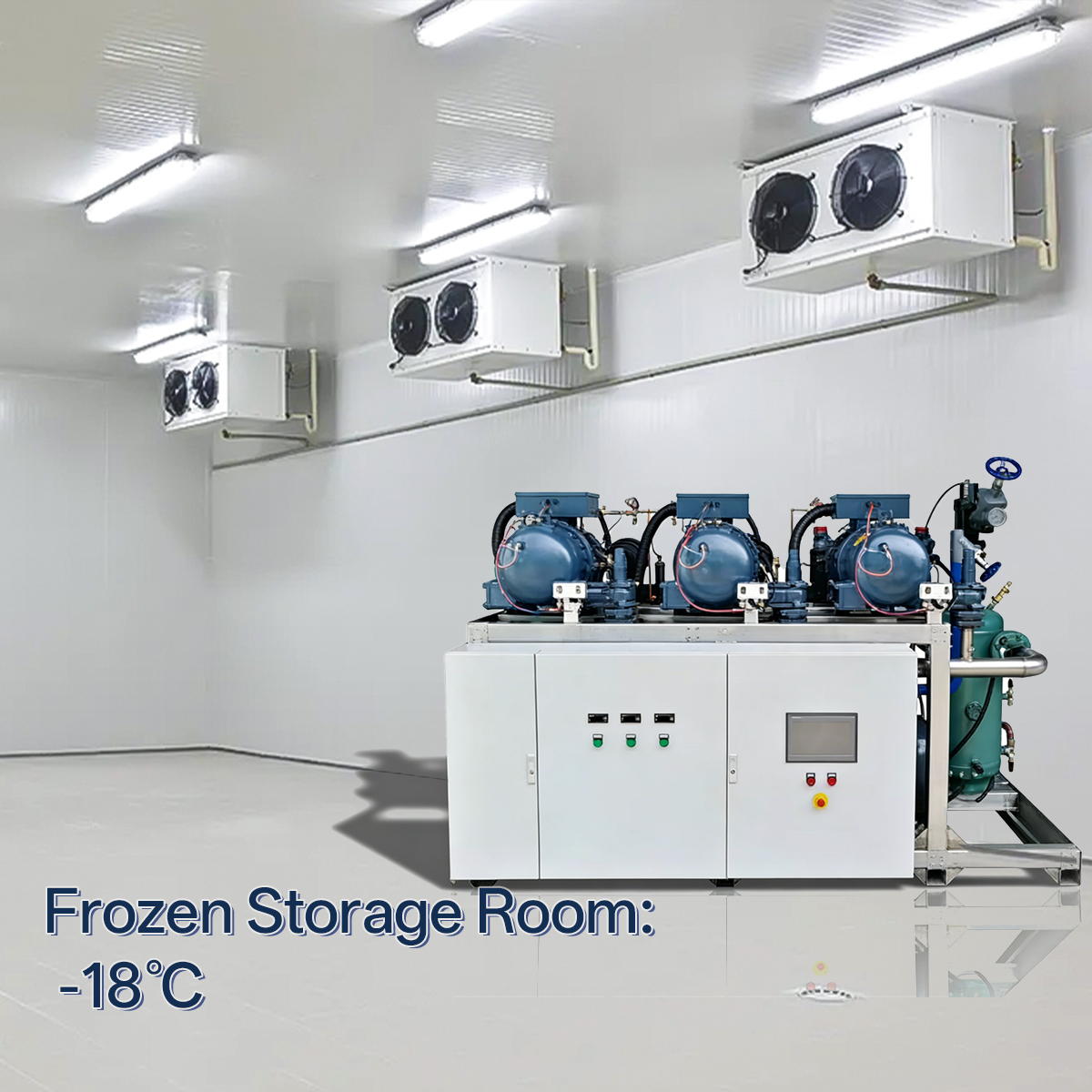
Deep Freezing | -18°C to -25°C | Long-term storage, seafood, bulk frozen products |
Shock Freezing / Blast Chilling | -35°C or below | Rapid freezing for fish, bakery products, prepared meals |
Blast chillers and shock freezers are specialized rapid-cooling equipment that bring products through the maximum ice crystal formation zone (-1°C to -5°C) as quickly as possible, minimizing cellular damage and preserving texture and quality in fresh fish and seafood applications.
Core Components of a Cold Room System
1. Refrigeration System
The heart of any cold room. Ammonia (R-717) refrigeration systems remain the dominant choice for large-scale industrial food cold storage due to their superior thermodynamic efficiency and zero ozone depletion potential. CO₂ (R-744) transcritical systems are gaining rapidly due to their low global warming potential (GWP = 1) and excellent performance in medium-temperature applications. Many modern facilities use ammonia/CO₂ cascade systems that combine the advantages of both refrigerants. Refrigeration equipment typically accounts for up to 70% of total cold storage construction costs, making system selection a critical investment decision.
2. Evaporator Units
Direct expansion (DX) evaporators or recirculation gas coolers distribute cooling within the storage chamber. Industrial evaporators feature corrosion-resistant coils, defrost systems (electric, hot gas, or off-cycle), and programmable controllers for precise temperature maintenance.
3. Cold Room Panels and Structure
Sandwich panel construction with rigid polyurethane foam (PUF) insulation is the standard for modern cold storage. Panel thicknesses range from 80mm to 200mm depending on the target temperature and ambient conditions. Key panel specifications include:
Wall and ceiling panels: Typically 100–150mm PUF for chilled rooms, 150–200mm for frozen storage
Floors: Insulated with pressure-impregnated PIR or PUF, designed to support heavy racking and forklift traffic
Doors: Insulated swing doors or high-speed rapid-roll doors for frequently accessed chambers
Seal systems: Gasket systems, air curtains, and dock seals minimize infiltration heat loads
4. Temperature Monitoring and Control
IoT-enabled temperature monitoring systems provide real-time visibility across all storage zones, automated deviation alerts, and digital audit trails for regulatory compliance. Multi-point temperature mapping identifies hot and cold spots within the chamber, enabling optimization of air circulation and product placement.
5. Racking and Material Handling
Adjustable pallet racking systems maximize storage density while allowing First-In-First-Out (FIFO) inventory management. Drive-in racking suits high-density single-product storage, while selective racking provides accessibility for mixed-product inventories. Floor load capacity and drainage provisions are critical design considerations for food processing cold rooms.
Cold Storage Equipment Automation Levels
Level | Description | Key Features | Best For |
|---|---|---|---|
Manual | Basic cold room with simple on/off thermostat control | Single-point temperature setting, basic evaporator, minimal monitoring | Small operations, low throughput, tight budget |
Entry-Level | Multi-temperature zone capable with basic data logging | Digital controller, multi-stage defrost, manual temperature recording | Medium processors, single-product storage |
Moderate | Automated defrost cycles, scheduled temperature profiling | Programmable defrost timers, remote alarm notification, semi-automated refrigeration trim control | Multi-product facilities, regulatory compliance needed |
Advanced | Full IoT integration, predictive maintenance, energy optimization | Real-time temperature monitoring, analytics dashboards, automated deviation alerts, FSMA 204 traceability records | Large-scale processors, export-grade facilities, pharmaceutical-grade storage |
Cold Storage Capacity Reference Guide
Capacity Level | Storage Volume | Typical Pallet Positions | Refrigeration Capacity | Investment Range |
|---|---|---|---|---|
Small-Scale | 50–200 m³ | 20–80 pallets | 10–30 kW | Lower investment, 1-2 year ROI |
Medium-Scale | 200–1,000 m³ | 80–400 pallets | 30–150 kW | Moderate investment, 2-3 year ROI |
Large-Scale | 1,000–5,000 m³ | 400–2,000 pallets | 150–750 kW | Higher investment, 3-4 year ROI |
Industrial | 5,000+ m³ | 2,000+ pallets | 750 kW+ | Significant investment, economies of scale apply |
2026 Cold Storage Industry Trends
Natural Refrigerants Take Center Stage
Regulatory pressure and sustainability commitments are accelerating the shift from synthetic refrigerants (HFCs) to natural refrigerants. Ammonia/CO₂ cascade systems now represent the fastest-growing segment in industrial cold storage equipment. The EU F-Gas Regulation continues to phase down HFC use, making natural refrigerant systems increasingly attractive from both regulatory and lifecycle cost perspectives.
Digital Traceability and FSMA 204 Compliance
The FDA's Food Traceability Final Rule (FSMA 204) requires covered facilities to maintain electronic, interoperable traceability records for foods on the Food Traceability List. Cold storage operators handling products such as fresh leafy greens, melons, tomatoes, and certain cheeses must implement digital temperature tracking systems that generate automated compliance reports.
Energy Optimization and Heat Recovery
Energy is the largest operating cost for cold storage facilities. Advanced systems now incorporate heat recovery from refrigeration condensers for facility heating, demand response integration for grid optimization, and variable frequency drive (VFD) compressors that adjust capacity to actual cooling loads rather than running at full load continuously.
5 Key Selection Criteria for Cold Storage Equipment
1. Product Temperature Requirements
Match the refrigeration system's capacity and design to the most demanding product you store. Building in a temperature margin of 1–2°C below the minimum required product temperature provides a safety buffer during door openings, product loading, and peak ambient temperatures.
2. Ambient Climate Conditions
Cold storage equipment must be specified with the local ambient temperature in mind. Facilities in hot climates (Middle East, Southeast Asia, tropical regions) require larger condensers and more robust insulation than those in temperate zones. This is particularly relevant for equipment exported to markets across the 100+ countries served by SD Henger Group.
3. Refrigerant Choice and Regulatory Alignment
Evaluate current and anticipated refrigerant regulations in your target markets. Equipment specified today should remain compliant with evolving regulations over its 15–20 year operational lifespan. Natural refrigerant systems carry lower long-term regulatory risk.
4. Serviceability and Local Support
Complex ammonia refrigeration systems require trained technicians and a reliable service network. Consider the availability of spare parts, service contracts, and technical support in your operating region. Systems with modular designs allow components to be replaced without shutting down the entire facility.
5. Scalability for Future Growth
Design your cold storage capacity to accommodate 3–5 years of growth. Modular panel construction allows expansion of cold room volume without rebuilding. Ensure electrical and refrigeration infrastructure has spare capacity for future additions.
5 Common Cold Storage Equipment Mistakes to Avoid
Under-specifying insulation thickness: Saving on panel costs while paying higher energy bills for 20+ years is a false economy. Choose insulation to specification, not to budget.
Ignoring infiltration heat loads from doors: Rapid-roll doors and air curtains are not optional accessories—they directly impact energy consumption and product temperature stability.
Failing to plan for drainage: Cold room floors accumulate condensation and washdown water. Proper floor slope and drain placement prevent water pooling, ice buildup, and hygiene hazards.
Choosing lowest-first-cost equipment: Compressor efficiency, controller reliability, and build quality vary enormously. A cheap condenser that fails after 5 years costs far more than investing in quality upfront.
No temperature mapping or validation: A cold room that averages +2°C may have hot spots at +8°C in corners or near loading doors. Commission with a calibrated temperature mapping study before accepting the facility.
Frequently Asked Questions
What is the difference between a cold room and a freezer room?
A cold room (chilled room) maintains temperatures above 0°C, typically between +1°C and +4°C, suitable for fresh meat, dairy, and produce. A freezer room operates below 0°C, typically at -18°C to -25°C, for long-term frozen food storage. The insulation thickness, refrigeration capacity, floor construction, and door specifications differ significantly between the two.
How long does it take to build a cold storage facility?
A small-scale prefabricated cold room (50–200 m³) can be installed in 2–4 weeks. A medium-scale custom cold storage facility typically requires 8–16 weeks from design to commissioning. Large-scale industrial cold warehouses may take 6–12 months or longer depending on complexity and site conditions.
What maintenance does cold storage equipment require?
Monthly tasks include inspecting door seals and gaskets, cleaning condenser coils, checking refrigerant pressure, and verifying temperature recorder accuracy. Annual tasks include professional refrigeration system inspection, evaporator coil cleaning, defrost system calibration, and electrical safety checks. IoT monitoring systems can alert operators to performance degradation before failures occur.
Can cold storage equipment be customized for specific products?
Yes. Equipment can be configured for specific humidity control (dry-aged beef requires different humidity than fresh produce), multi-temperature zoning within a single facility, blast chilling capability for specific product categories, and halal or kosher compliance configurations for relevant markets.
What is the typical ROI for cold storage equipment?
Return on investment depends on the value of product stored, local energy costs, and utilization rate. Well-designed cold storage typically achieves ROI within 2–4 years through reduced product spoilage, extended shelf life enabling longer distribution reach, and premium pricing for consistently high-quality products.
Conclusion: Building a Cold Chain That Protects Your Products
The cold storage market's strong growth trajectory reflects a fundamental truth: as global food supply chains grow longer and more complex, the importance of reliable cold chain infrastructure only increases. For food processing facilities, cold storage equipment is not merely an infrastructure purchase—it is a quality assurance system, a regulatory compliance tool, and a competitive advantage.
Whether you are installing a single blast chiller for a boutique meat processor or building a multi-room industrial cold warehouse for a large-scale operation, the principles remain the same: specify to your product's actual requirements, plan for your 5-year growth trajectory, invest in reliable refrigeration equipment, and implement digital monitoring for traceability and compliance.
Need Custom Cold Storage Equipment Solutions?
SD Henger Group designs and manufactures cold room and cold storage equipment for food processing facilities across 100+ countries. From single blast chillers to complete multi-temperature cold storage installations, our engineering team provides turnkey solutions tailored to your product requirements, facility layout, and growth plans.
Contact us today to discuss your cold storage project requirements and receive a customized equipment proposal.