

Meat Cutting & Processing Line: Complete Solutions for Modern Meat Processors 2026


SD Henger Group — Food Processing Equipment Solutions
Meat Processing Equipment
Meat Cutting & Processing Line: Complete Solutions for Modern Meat Processors 2026
May 5, 2026 ✍️ SD Henger Group Meat Processing Equipment
Table of Contents
The difference between a profitable meat processing operation and one that struggles often comes down to what happens after the carcass arrives at the cutting floor. A well-designed cutting line reduces bottlenecks, controls labor costs, produces consistent portions, and keeps foreign material contamination out of your packaged products.
The global meat processing equipment market continues to expand rapidly, with processors in emerging markets investing heavily in modern cutting and portioning systems to compete in both domestic and export channels. This guide walks through everything you need to know about designing, sourcing, and specifying a complete meat cutting & processing line in 2026.
1. Why the Cutting Line Design Determines Your Operation's Success
A meat cutting & processing line is more than a row of machines — it's an integrated system. Throughput, yield, hygiene, worker safety, and product quality all depend on how well the entire line is engineered together.
The most costly mistake is buying individual machines that look good on paper but don't work as a cohesive system. Mismatched conveyor speeds, inconsistent product temperatures, and poorly positioned quality checkpoints can reduce yield by 8–12% — losses that add up across every shift, every day.
Key Insight: Over a 10-year operating period, the total cost of ownership of a meat cutting line is typically 3–5× the initial purchase price. Labor, yield loss, downtime, and maintenance are the dominant costs — not the equipment itself. Spec for the system, not just the individual machines.
2. The 8-Stage Meat Cutting & Processing Line: Step by Step
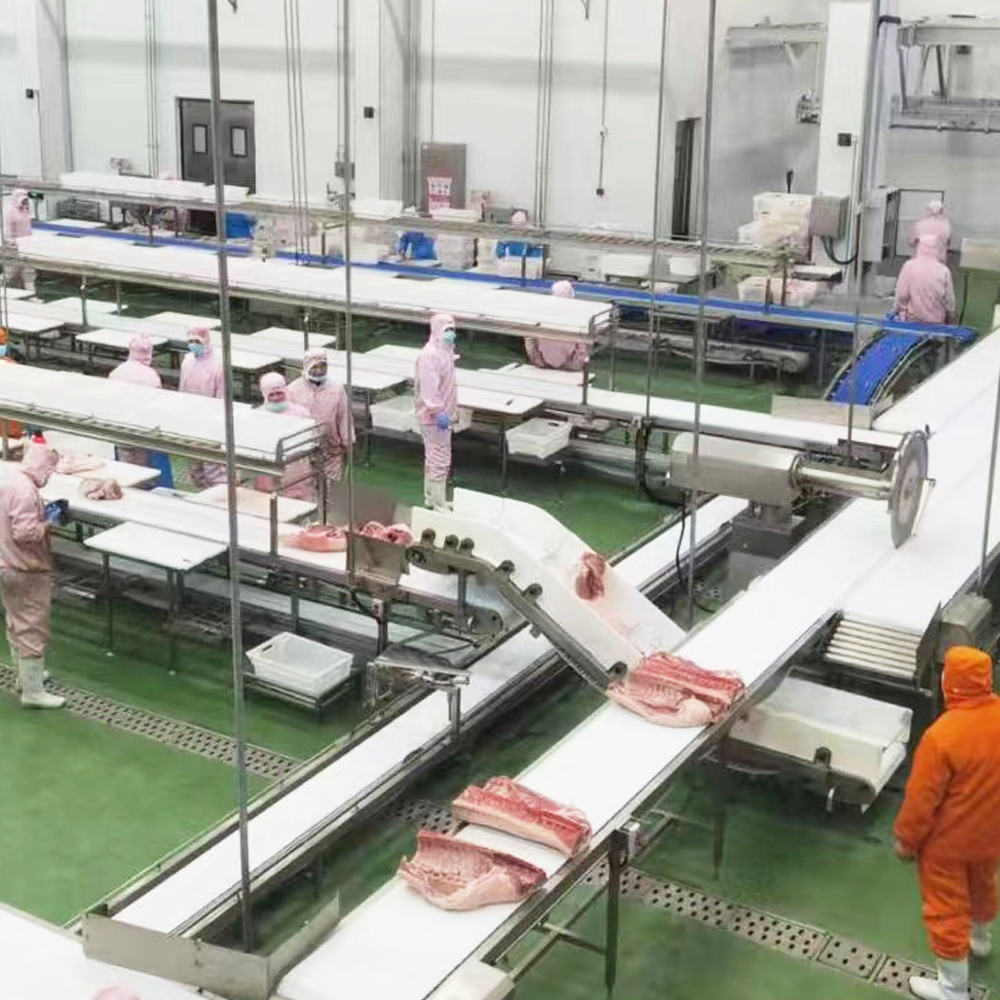
A complete meat cutting & processing line moves product through eight distinct stages. Each stage must be properly designed and sized to avoid creating downstream bottlenecks.
Stage 1 — Carcass Reception & Pre-Conditioning
Carcasses arrive from slaughter operations and must be properly pre-conditioned to a safe cutting temperature, typically below 7°C (44.6°F). Temperature control at this stage is critical — warm meat is harder to cut cleanly, produces more trim loss, and presents food safety risks.
Stage 2 — Carcass Breaking / Primary Cuts
The carcass is divided into primal cuts — loin, rib, chuck, brisket, round, and flank. This is typically done using circular saws or bandsaws. Many modern operations use semi-automatic breaking saws with conveyor feeding to improve consistency and reduce operator fatigue.
Stage 3 — Secondary Cutting & Portioning
Primal cuts are broken down into sub-primal and retail portions. The level of automation at this stage varies widely — from manual station work to semi-automatic portion cutters with programmable cut patterns. Well-configured portion-cutting systems can achieve high consistency with minimal give-away.
Stage 4 — Deboning & Trim Recovery
Skilled boners remove bones from primal cuts while maximizing lean meat recovery. Semi-automatic bone saws and guide jigs help operators work more efficiently and consistently. Manual inspection stations are essential to catch any remaining bone fragments before packaging.
Stage 5 — Quality Grading & Sorting
Each portion is evaluated for fat depth, color, weight consistency, and overall appearance. Manual grading with structured checklists is the most common approach for medium-scale processors, while automated checkweighers and vision grading systems are available for higher-volume operations.
Stage 6 — Seasoning, Marination & Value-Added Processing
For processors targeting retail and foodservice channels, this stage adds tumbling, injecting, or coating systems. Mechanical tumblers and marinade injectors ensure consistent seasoning penetration that is difficult to achieve with manual processes at scale.
Stage 7 — Weighing, Labelling & Packaging
Portions are weighed, labelled with batch and traceability codes, and packaged under modified atmosphere (MAP) or vacuum skin packaging (VSP). Modern packaging lines integrate with upstream data to support full lot traceability — a growing requirement in EU, UK, and Asian export markets.
Stage 8 — Cold Chain Preparation & Dispatch
Packaged products are blast chilled to core temperature below 3°C before entering the cold storage distribution chain. Line design must account for the smooth handoff between the processing floor and cold storage to prevent temperature fluctuations.
3. Automation Options: Matching Your Budget and Scale
Not every processor needs the same level of automation. The right configuration depends on your production volume, available labor, budget, and target markets. Here's a realistic breakdown of the most common configurations available:
Configuration | Automation Level | Labor Requirement | Best Suited For | Typical Yield |
|---|---|---|---|---|
Manual station layout | Basic | High — full manual operation | Small processors, specialty cuts, low-volume operations | Dependent on operator skill |
Semi-automatic with conveyors | Entry-Level | Medium — operators at key stations | Medium-scale processors, emerging market expansion | Steady, consistent output |
Mechanical portioning + checkweighing | Moderate | Low-Medium — fewer operators needed | High-volume retail and foodservice producers | +3–5% vs. manual |
Integrated line with grading & packaging | High | Low — monitoring-focused staffing | Large processors, export-grade facilities | +5–8% vs. manual |
Most meat processors in Asia, Africa, Latin America, and the Middle East operate successfully with entry-level to moderate automation — configurations that balance capital investment with practical throughput gains. Fully automated lines are typically reserved for very large-scale operations with high labor costs and strict quality consistency requirements.
4. Capacity Reference: Finding the Right Line Size
Choosing the wrong line capacity is one of the most common and costly mistakes in plant design. Oversizing creates idle capital. Undersizing creates bottlenecks that cascade through your entire operation.
Operation Scale | Line Capacity | Carcasses/Hour | Typical Configuration |
|---|---|---|---|
Small / Specialty | 500–1,500 kg/hr | 10–30 head/hr | Manual stations + conveyor system |
Medium | 1,500–5,000 kg/hr | 30–100 head/hr | Semi-auto saws + portion cutter + checkweigher |
Large / Industrial | 5,000–15,000 kg/hr | 100–300 head/hr | Full portioning line + grading + integrated packaging |
Enterprise / Export | 15,000–30,000+ kg/hr | 300–600+ head/hr | Multi-line setup with full automation integration |
⚠️ Capacity Planning Tip: Always spec your line for peak-season throughput, not average throughput. A line that runs at 70% capacity most of the year and bottlenecks during peak demand loses more total volume than the cost of slightly oversizing the investment.
5. Hygiene Design: Meeting Global Market Standards
Every piece of equipment on your meat cutting & processing line must be designed for effective wet cleaning. Stainless steel grades 304 or 316 are the industry standard. Equipment with crevices, dead spaces, or hard-to-reach bearings will harbor Listeria, Salmonella, and E. coli — creating ongoing food safety risks and expensive product recalls.
For processors targeting EU, US, or premium Asian export markets, hygiene design should align with internationally recognized standards:
Stainless steel construction — grades 304/316 for all product contact surfaces
HACCP compliance — critical control points designed into the line from day one
Easy-clean design — rounded corners, minimal dead zones, removable components for thorough cleaning
CIP compatibility — Clean-in-Place capability for reduced sanitation time
Traceability systems — batch coding and lot tracking integrated into the packaging line
Chinese-manufactured equipment has made significant advances in hygiene design over the past decade. Leading manufacturers now offer equipment that meets EU and international food safety standards, making it competitive for both domestic and export market requirements.
6. 5 Common Mistakes When Sourcing a Meat Cutting Line
1. Buying machines instead of a system
Individually excellent machines don't automatically make an excellent line. Always evaluate how the machines work together — conveyor speeds, temperature consistency, and quality checkpoint placement matter as much as the cutting equipment itself.
2. Ignoring yield from day one
Yield is the most important financial metric on your cutting floor. A 1% yield improvement on a 10,000 kg/day operation adds 100 kg of sellable product every day. At $4/kg, that's $400/day — $146,000/year. The equipment that costs a bit more upfront often pays for itself through yield within 12 months.
3. Underestimating sanitation downtime
Every hour your line is down for cleaning is lost production. Choose equipment that is quick to disassemble and reassemble, and ensure your sanitation protocol is factored into your production scheduling.
4. Not planning for product changeover
If you process multiple species (beef, pork, lamb) or different product formats, your line needs quick-change tooling and rapid recipe switching. Lines without this flexibility create expensive downtime whenever product specifications change.
5. Skipping the floor plan and workflow review
Before purchasing, ensure your facility can accommodate the equipment physically — including clearance for operators, maintenance access, drainage slopes, and cold room handoff points. A thorough workflow review before purchase prevents expensive retrofitting later.
Frequently Asked Questions
Q: What is the typical lead time for a complete meat cutting line?
A: Lead times vary by configuration and manufacturer. Standard semi-automatic lines typically ship within 4–8 weeks. Custom integrated lines may require 12–20 weeks for design, manufacturing, and factory acceptance testing. Planning ahead is essential, especially for export shipments.
Q: Can a meat cutting line handle multiple species (beef, pork, lamb)?
A: Many lines are designed for flexibility with quick-change tooling. Some processors operate dedicated lines for different species to maximize throughput, while others use versatile equipment that can be reconfigured for different carcass types. Your choice depends on your product mix and volume.
Q: What maintenance is required for a meat cutting & processing line?
A: Regular maintenance includes blade sharpening or replacement, conveyor belt tensioning and inspection, lubrication of moving parts, and daily sanitation checks. Most manufacturers provide a maintenance manual and offer spare parts packages. Preventive maintenance schedules should be established from day one.
Q: How do I ensure my equipment meets export market requirements?
A: Identify the specific requirements of your target export market (EU, Middle East, Southeast Asia, etc.) and confirm equipment compliance during the purchasing stage. Key requirements typically include stainless steel construction, traceability capabilities, HACCP compatibility, and relevant certification documentation.
Q: What is the minimum floor space required for a meat cutting line?
A: A small manual cutting line can operate in 100–200 square meters. A medium-scale semi-automatic line typically requires 300–500 square meters. Large industrial configurations may need 800–1,500+ square meters including cold storage handoff areas. Your equipment supplier should provide a detailed layout plan.
Ready to Build Your Meat Cutting & Processing Line?
SD Henger Group engineers and manufactures complete meat cutting & processing lines for processors in 100+ countries. Whether you need a single portioning station or a turnkey integrated line — we can specify, build, and commission the right system for your operation.
Related News
-
-
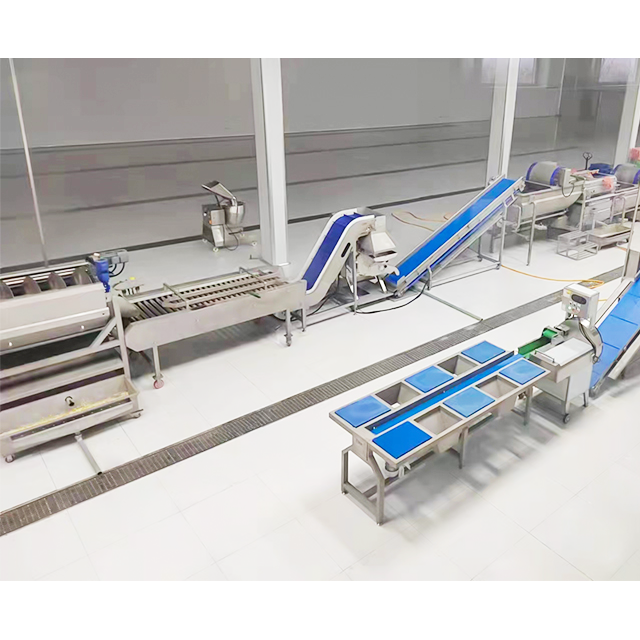 This article explores fruit and vegetable washing line design for 2026, focusing on organic produce compliance, post-wash drying, and optical sorting. It compares bubble, brush, spray, and ultrasonic washing technologies; explains air-knife and centrifugal drying; outlines four capacity tiers; and identifies five industry trends and five common purchasing errors. The guide is written for processors serving organic, fresh-cut, and export markets who need practical, mechanical equipment selection advice.Industry Insights
 -
 You're Invited: Meet Henger at Seoul Food & Hotel 2026!안녕하세요,We are thrilled to invite you to connect with Henger Manufacturing (Shandong) Machinery Technology Co., Ltd. at the upcoming Seoul Food & Hotel 2026, the premier food processing and hospitality industry event in South Korea! Event DatCompany Dynamic
