Cold Room & Cold Storage Equipment: Modular Refrigeration Systems for Food Processing in 2026


Cold Room & Cold Storage Equipment: Modular Refrigeration Systems for Food Processing in 2026
Cold storage is no longer just a warehouse with a cooling unit—it is the backbone of modern food processing. Whether you are running a slaughterhouse, a dairy plant, a seafood processing facility, or a central kitchen, the quality and design of your cold room directly determines product shelf life, food safety compliance, and operational costs. With the global cold storage market reaching an estimated USD 166.16 billion in 2026 and projected to grow at a CAGR of 4.67% through 2031, processors worldwide are upgrading their refrigeration infrastructure. This guide walks you through the equipment, technologies, and decision factors that matter in 2026.
Why Cold Storage Is a Strategic Investment for Food Processors
Every link in the food supply chain depends on temperature control—but for processors, the stakes are uniquely high. A single cold room failure can spoil thousands of kilograms of product, trigger regulatory violations, and erode buyer trust. The cold room market alone is valued at approximately USD 142.8 billion in 2026, with a forecast to reach USD 276 billion by 2036, driven largely by meat, dairy, and seafood processing expansion across Asia Pacific, the Middle East, and Africa.
Three forces are reshaping cold storage demand in 2026. First, protein consumption growth in emerging markets is driving new slaughterhouse and processing plant construction, each requiring integrated cold rooms and blast freezers. Second, stricter food safety regulations—including HACCP and ISO 22000 requirements—are forcing older facilities to replace underperforming refrigeration systems. Third, energy costs remain volatile, making efficiency-focused cold room design a financial priority, not just an environmental one.
Types of Cold Storage Equipment for Food Processing
Choosing the right cold storage system starts with understanding the main equipment categories and their specific roles in a processing environment.
1. Modular Walk-In Cold Rooms
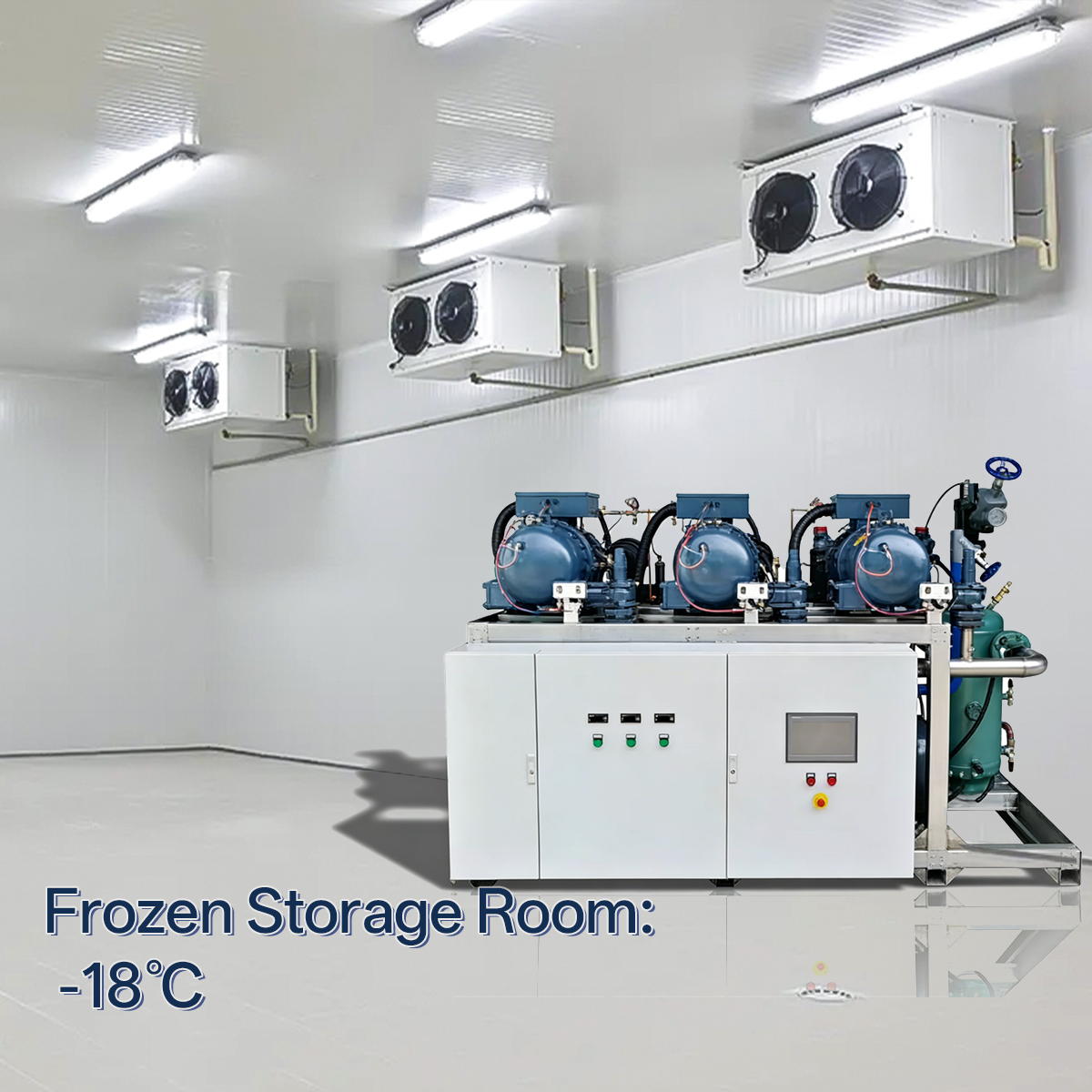
Modular cold rooms use prefabricated insulated panels (typically polyurethane or PIR sandwich panels) that assemble on-site. This design offers flexibility: you can expand capacity later, reconfigure the layout, or even relocate the entire cold room. Panel thicknesses range from 75mm to 150mm, with thicker panels delivering better thermal insulation for deep-freeze applications. For food processors, modular cold rooms are the most practical solution—they install in days rather than weeks, and the panel-based construction makes hygiene maintenance straightforward.
2. Blast Freezers & Quick-Freeze Tunnels
Blast freezers rapidly bring product temperature down from ambient or processing temperature to -18°C or lower within hours. In meat and seafood processing, blast freezing is essential: slow freezing creates large ice crystals that damage cell structure and degrade texture upon thawing. A properly sized blast freezer can freeze product 5 to 10 times faster than a static cold room, preserving quality and extending shelf life. Quick-freeze tunnels, which use continuous conveyor systems, are the high-throughput option for large-scale poultry and processed meat operations.
3. Refrigeration Units & Condensing Systems
The heart of any cold storage system is the refrigeration unit. In 2026, the industry is in the middle of a significant transition from synthetic HFC refrigerants to natural refrigerants—primarily ammonia (R717) and CO₂ (R744). Ammonia systems deliver 10–20% better energy efficiency than equivalent HFC systems and have zero global warming potential. CO₂ cascade systems are gaining ground in low-temperature applications like blast freezing. For processors building new facilities, choosing a natural refrigerant system from the start avoids the cost and complexity of future retrofits driven by tightening environmental regulations.
4. Cold Storage Warehouses & Distribution Cold Rooms
Larger operations that handle finished goods inventory require warehouse-scale cold storage with racking systems, forklift access, and dock-level loading bays. These are typically built as either modular panel structures or traditional insulated construction. Multi-temperature zones within a single warehouse allow processors to store fresh (0–4°C), chilled (-2–2°C), and frozen (-18°C to -25°C) products under one roof.
• Modular cold room: Fast install, flexible, 75–150mm panels, -5°C to +5°C (chill) or -18°C to -25°C (freeze)
• Blast freezer: Rapid freezing, -30°C to -40°C air temp, 4–24 hour cycle, meat/seafood/poultry
• Quick-freeze tunnel: Continuous high-throughput, IQF capability, conveyor system, large-scale poultry/processed meat
• Cold storage warehouse: Large-volume inventory, multi-temperature zones, racking and logistics integration
• Refrigeration unit: Ammonia/CO₂/HFC options, condensing unit + evaporator, the core of every system
Energy Efficiency: The Hidden Profit Lever in Cold Storage
Refrigeration typically accounts for 40–60% of a food processing facility's total electricity consumption. Improving cold room energy efficiency is therefore one of the highest-ROI operational investments a processor can make. Natural refrigerant systems paired with heat recovery can reduce combined electricity and gas consumption by 15–30% compared to legacy HFC-based systems in many climate zones.
Several practical efficiency measures deliver fast payback:
- High-efficiency insulation panels: Upgrading from 100mm to 150mm PIR panels can cut thermal transmission by 30–40%, reducing compressor runtime.
- Variable-speed compressors: Unlike fixed-speed units that cycle on/off, variable-speed compressors modulate output to match actual cooling load, saving 20–35% in energy.
- LED lighting with motion sensors: Cold rooms are often lit 24/7; motion-activated LED lighting cuts lighting energy by 60–80%.
- Door management: High-speed roll-up doors and strip curtains minimize cold air loss during frequent access—a simple measure that can reduce refrigeration load by 10–15%.
- Heat recovery systems: Waste heat from refrigeration compressors can preheat water for cleaning and sanitation, turning a cost into a resource.
Temperature Monitoring and Food Safety Compliance
Modern cold storage equipment increasingly integrates digital temperature monitoring and alarm systems that log data continuously and alert operators to deviations before product is compromised. These systems support HACCP compliance by providing auditable temperature records—a requirement that is becoming mandatory in export-oriented food markets. A practical configuration includes wireless sensors placed at multiple points within each cold room, a central data logger, and SMS or app-based alerts for out-of-range conditions. While not as sophisticated as full IoT platforms, these systems are reliable, affordable, and directly address the most common audit finding in food processing facilities: inadequate temperature documentation.
Selecting the Right Cold Storage Equipment: A Practical Framework
Purchasing cold storage equipment involves balancing multiple variables. Here is a practical decision framework organized by operational scale:
• Modular cold room: 20–50 m², 100mm panels
• Monoblock refrigeration unit: plug-and-play, reduced installation complexity
• Manual temperature logging: thermometer + log sheet (upgrade to digital logger when budget allows)
• Single temperature zone: chill or freeze, not both
Medium-Scale Processing (5–20 tons/day):
• Modular cold room: 50–150 m², 100–120mm panels, possibly dual-zone
• Split refrigeration system: separate condensing unit + evaporator, ammonia or CO₂ option
• Digital temperature monitoring: multi-point sensors with basic alarm
• Dedicated blast freezer: 2–5 ton/batch capacity
Large-Scale Processing (20+ tons/day):
• Cold storage complex: multiple rooms, 150mm panels, multi-temperature zones
• Central ammonia or CO₂ refrigeration plant with variable-speed compressors
• Comprehensive monitoring: HACCP-compliant digital logging, remote alert, backup power integration
• Blast freezer + quick-freeze tunnel: for high-throughput frozen product lines
• Heat recovery system: preheat cleaning water, reduce overall plant energy cost
2026 Trends Shaping Cold Storage Equipment
1. The Natural Refrigerant Transition Accelerates
The Kigali Amendment to the Montreal Protocol continues to phase down HFC refrigerants globally. In 2026, ammonia and CO₂ systems have moved from "early adopter" to "mainstream choice" for new food processing cold storage projects, particularly in markets exporting to the EU where environmental compliance is a market access requirement. Ammonia systems offer proven reliability and the best energy efficiency for industrial-scale applications, while CO₂ transcritical systems are gaining in smaller and medium-sized installations.
2. Modular and Prefabricated Design Dominates New Builds
Modular cold rooms now account for the majority of new food industry installations. The speed advantage is decisive: a modular cold room can be operational within 5–10 days of panel delivery, compared to weeks for traditional brick-and-mortar construction. For processors expanding rapidly or entering new markets, this time savings translates directly into faster revenue generation. Modular systems also offer clear hygiene advantages—smooth panel surfaces with rounded internal corners eliminate bacterial harborage points and simplify CIP (clean-in-place) compatibility.
3. Energy Efficiency Becomes a Competitive Differentiator
With electricity prices remaining elevated in many regions, the operating cost of a cold room over its 15–20 year lifespan far exceeds its purchase price. Buyers in 2026 increasingly evaluate cold storage equipment on total cost of ownership rather than upfront price. Features like variable-speed compressors, high-performance insulation, and heat recovery shift from "optional extras" to "expected standard" in competitive tenders.
4. Food Safety Documentation Goes Digital
Paper-based temperature logs are rapidly being replaced by digital monitoring systems that provide continuous, tamper-proof records. Export-oriented food processors in particular are adopting these systems to satisfy importing country requirements for cold chain integrity documentation. The practical implementation is straightforward—wireless sensors, a central logger, and automated reporting—and the payback comes through reduced audit risk and fewer rejected shipments.
5. Emerging Market Demand Drives Equipment Standardization
The Asia-Pacific, Middle East, and Africa regions are experiencing the fastest growth in cold storage construction, driven by expanding meat and poultry processing sectors. For equipment suppliers, this creates demand for standardized, reliable cold room designs that can be shipped, installed, and maintained with minimal on-site expertise. Turnkey modular solutions—where panels, refrigeration units, doors, lighting, and monitoring arrive as a complete package—are increasingly preferred by buyers in these markets.
Common Mistakes When Buying Cold Storage Equipment
- Undersizing the system: Many processors budget for current production volumes but fail to plan for growth. A cold room that is adequate today may constrain operations in two years. Add at least 20–30% capacity buffer for future expansion.
- Ignoring door traffic patterns: A well-insulated cold room loses efficiency if doors open frequently without air curtains or strip barriers. Design the layout to minimize door openings and consider ante-rooms for high-traffic areas.
- Overlooking floor insulation: Cold rooms lose significant thermal energy through uninsulated or poorly insulated floors. Proper floor insulation with a vapor barrier is essential, especially for freeze-level rooms where frost heave can structurally damage the floor slab.
- Choosing the wrong refrigerant for the application: Ammonia is highly efficient but requires trained operators and safety protocols. CO₂ operates at higher pressures and needs specialized components. Match the refrigerant choice to your operational capability and local regulatory environment.
- Neglecting maintenance access: Refrigeration units, evaporators, and control panels need regular servicing. Ensure adequate clearance around equipment and plan for access without disrupting cold room operations.
Looking for Cold Storage Equipment for Your Food Processing Facility?
SD Henger Group supplies modular cold rooms, blast freezers, and complete cold storage solutions designed for meat, poultry, seafood, dairy, and processed food operations. Our equipment serves processors in over 100 countries, with designs adapted to local voltage, climate, and regulatory requirements. From a single modular cold room to a multi-zone cold storage complex, we configure systems to match your throughput, product type, and budget.
Contact us today to discuss your cold storage requirements. Send us your specifications—including required temperature range, daily throughput, available space, and local power supply—and our engineering team will provide a tailored equipment proposal.
Frequently Asked Questions
What temperature range do I need for meat cold storage?
Fresh meat chilling: 0°C to 4°C. Frozen meat storage: -18°C to -25°C. Blast freezing operates at air temperatures of -30°C to -40°C to achieve rapid core temperature reduction. Different products and regulatory standards may require specific temperature profiles—always confirm with your local food safety authority.
How long does it take to install a modular cold room?
A standard modular cold room (20–100 m²) can typically be installed within 5–10 working days after panel delivery, assuming a prepared level floor and available electrical connection. Larger multi-room complexes may require 3–6 weeks depending on complexity.
What is the difference between a cold room and a blast freezer?
A cold room maintains product at a stable storage temperature. A blast freezer actively reduces product temperature from ambient or processing temperature to frozen state as quickly as possible. Most food processing facilities need both: blast freezers for initial freezing, cold rooms for holding frozen inventory.
Which refrigerant is best for industrial cold storage?
Ammonia (R717) offers the best energy efficiency and lowest long-term operating cost for industrial-scale systems (100kW+ cooling capacity). CO₂ (R744) is increasingly popular for medium-scale applications and low-temperature freezing. Both are natural refrigerants with zero or near-zero global warming potential. The best choice depends on your facility size, operator training, and local safety regulations.
How do I maintain HACCP compliance in cold storage?
Implement continuous digital temperature monitoring with automated logging, set alert thresholds for temperature deviations, conduct regular calibration of sensors, maintain cleaning and maintenance records, and train staff on cold room operating procedures. Many export markets now require digital (not paper-based) temperature records for imported food products.