

Poultry Slaughter Equipment: The Complete Technology Guide to Stunning, Automation & Line Efficiency in 2026


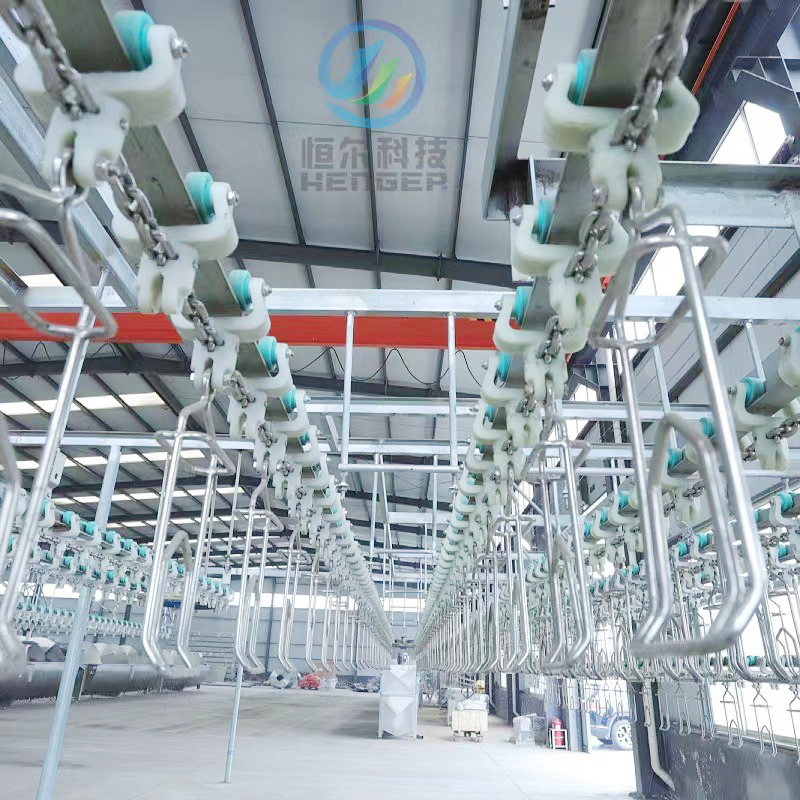
Poultry Slaughter Equipment: The Complete Technology Guide to Stunning, Automation & Line Efficiency in 2026
The global poultry processing equipment market stands at USD 4.97 billion in 2026 and is projected to reach USD 8.61 billion by 2035, growing at a CAGR of 6.3%. Behind these numbers lies a fundamental shift in how poultry is processed — from stunning technology to water management, from manual inspection to machine vision, from fixed-speed lines to adaptive automation. For processors building new facilities or upgrading existing ones, understanding each technology layer is no longer optional. It is the difference between a line that runs profitably and one that bleeds margin through yield loss, downtime, and compliance risk.
This guide walks through the complete technology stack of a modern poultry slaughter line — every stage, every critical decision, every trend shaping investment in 2026.
The 7-Stage Poultry Slaughter Process: Technology at Every Step
A broiler processing line is a tightly integrated sequence where each stage depends on the one before it. The right equipment choices at each stage determine throughput, yield, food safety, and ultimately the profitability of the entire operation.
Stage 1: Live Bird Reception & Handling
Birds arrive in transport crates or modules. Modern reception systems include automated crate destacking, controlled-environment holding areas with ventilation and misting, and dim blue lighting to keep birds calm. Low-stress handling at this stage directly affects meat quality — reduced wing flapping means fewer bruises, fewer broken bones, and higher-grade carcasses downstream.
Stage 2: Stunning — The Single Most Critical Technology Decision
Stunning renders birds insensible before slaughter, and the choice of stunning method has cascading effects on animal welfare compliance, meat quality, line speed, and market access. Two methods dominate in 2026:
| Parameter | Electrical Water Bath Stunning | Controlled Atmosphere Stunning (CAS) |
|---|---|---|
| Mechanism | Electric current passed through head via water bath | Birds exposed to CO₂ or inert gas (N₂/Ar) mixture in controlled chamber |
| Line capacity | Up to 12,000+ BPH | Up to 12,000 BPH (multi-chamber systems) |
| Meat quality | Risk of wing hemorrhaging, breast muscle blood spots, broken bones | Significantly fewer breast muscle defects, improved tenderness scores |
| Welfare compliance | Under increasing regulatory scrutiny in EU; requires strict parameter control | Preferred under EU welfare standards; recommended by HSA 2026 guidelines |
| Capital cost | Lower initial investment | Higher upfront cost (gas handling infrastructure, chambers) |
| Operating cost | Lower per-bird cost | Higher gas consumption; offset by better meat quality premiums |
| Best for | Cost-sensitive markets, high-throughput commodity chicken | Premium/export markets, EU-compliant facilities, higher-value products |
The trend is clear: CAS adoption is accelerating, particularly for processors targeting EU export markets or premium retail channels. A 2026 HSA technical note confirms that CAS systems with programmable gas concentration profiles now allow processors to fine-tune stunning parameters by bird weight and breed, achieving consistent insensibility with measurably better carcass quality than electrical methods.
Stage 3: Bleeding & Blood Collection
After stunning, automated neck cutting — either unilateral carotid and jugular cut for standard processing or a dorsal cut for Halal-compliant lines — initiates bleeding. Modern bleeding tunnels are enclosed, temperature-controlled, and designed for 90-120 second dwell times. Blood collection systems with dedicated drainage and conveyance prevent cross-contamination and enable by-product recovery for rendering or pet food applications.
Stage 4: Scalding & Defeathering
Scalding loosens feathers for removal. The choice between soft scald (50-53°C, preserves skin epidermis for fresh/chilled products) and hard scald (56-63°C, for frozen or further-processed products) directly affects downstream product value. Counter-flow scalders with precise temperature control and automatic water level management reduce energy consumption by 15-20% compared to older single-pass designs.
Defeathering uses rotating rubber picking fingers in a series of picker machines. Modern systems feature adjustable finger pressure by bird size, progressive picking stages (rough to fine), and integrated water spray to flush feathers continuously. The difference between a well-tuned defeathering line and a poorly maintained one can mean 1-2% yield loss through skin tears and wing damage.
Stage 5: Evisceration
Automated evisceration is where yield optimization meets food safety. The sequence — vent opening, opening cut, viscera draw, inspection, giblet harvesting, and final wash — must be executed without rupturing intestines or gallbladders. Modern evisceration lines use mechanical synchronization with the overhead conveyor, vacuum-assisted viscera extraction, and automated giblet separation (heart, liver, gizzard). Machine vision systems now inspect every carcass post-evisceration for fecal or bile contamination, triggering automatic diversion of affected birds.
Stage 6: Chilling
After evisceration and inspection, carcasses must be rapidly chilled to below 4°C to inhibit pathogen growth. Two primary methods exist: air chilling (dry, preferred for premium fresh products with no water uptake) and immersion chilling (water-based, higher throughput, with regulated moisture retention). Counter-flow chillers with screw auger or paddle agitation achieve uniform temperature reduction. Chiller water treatment with antimicrobial agents — peroxyacetic acid, chlorine dioxide, or approved organic acid blends — is standard practice for microbial control.
Stage 7: Grading, Weighing & Packing
Automated grading stations use in-motion weighing and machine vision to sort carcasses by weight class, conformation grade, and visual defects — all at line speed. Integrated label printers apply traceable barcodes linking each bird to its farm of origin, processing batch, and quality data. From grading, birds flow to portioning or whole-bird packing, then into cold storage at -1°C to +2°C.
Automation in the Poultry Slaughter Line: Where It Pays Off
Automation in poultry processing is not all-or-nothing. The most effective deployments target specific pain points where labor is costly, inconsistent, or hazardous.
| Automation Zone | Technology | Payback Driver |
|---|---|---|
| Live handling | Automated crate destacking, controlled atmosphere transport | Labor reduction, bird welfare improvement |
| Stunning | Programmable CAS multi-chamber systems | Meat quality premium (fewer defects), EU market access |
| Defeathering | Auto-adjusting picker pressure, progressive picking stages | Yield preservation (1-2% reduction in skin/meat loss) |
| Evisceration | Synchronized vacuum evisceration, automatic giblet harvesting | 12-15% labor reduction, 30% fewer contamination events |
| Quality inspection | Machine vision (multispectral imaging, AI defect detection) | Consistent grading, fewer returns, traceability compliance |
| Cut-up & deboning | Vision-guided robotic cutting, automated breast deboning | Yield increase (up to 1.5% on breast meat), labor savings |
The industry benchmark is shifting. As of 2026, high-speed lines above 6,000 BPH increasingly deploy vision-guided evisceration and automated grading as standard. The recent introduction of automated breast deboning systems — such as those demonstrated at JBT Marel's Meat ShowHow 2026 — signals that even the most labor-intensive post-slaughter operations are being redefined.
Water Management: The Hidden Cost Driver
Poultry processing is water-intensive. A typical broiler plant consuming 15-25 liters per bird translates to millions of liters daily for a mid-scale operation. Water use also means wastewater — with high biological oxygen demand (BOD), fat loads, and chemical residues — that must be treated before discharge.
Three technology levers are changing the equation:
- Closed-loop scalder water systems: Recirculate and treat scalder overflow, reducing fresh water draw by 30-40% while maintaining hygienic standards.
- Counter-flow chiller design: Water flows opposite to carcass movement, achieving more efficient heat exchange with lower total water volume.
- Advanced wastewater treatment: Dissolved air flotation (DAF) systems combined with membrane bioreactors recover fats and proteins as saleable by-products and enable water reuse in non-product-contact applications.
Processors who invest in water efficiency are not just reducing utility bills — they are future-proofing against tightening discharge permits and rising water costs in water-stressed regions.
Food Safety & Biosecurity in 2026: What Has Changed
The avian influenza (HPAI) outbreaks of 2024-2026 reshaped biosecurity thinking across the poultry supply chain. On the processing side, this has accelerated several technology trends:
- Rapid on-site pathogen testing: LAMP (loop-mediated isothermal amplification) and lateral flow immunoassays now provide Salmonella and Campylobacter results in 2-4 hours instead of days, enabling same-shift corrective action.
- Antimicrobial intervention integration: Multi-hurdle approaches combining organic acid sprays, UV-C treatment, and hot water immersion at multiple carcass contact points are replacing single-point interventions.
- Whole-line traceability: RFID tags and barcode systems now track birds from farm gate to finished pack, creating a data chain that supports rapid recall response and premium market access.
- Sanitary equipment design: USDA's updated hygienic equipment guidelines (March 2026) now explicitly cover poultry processing machinery, emphasizing sloped surfaces, sealed bearings, and tool-free disassembly for cleaning.
Capacity Planning: Matching Equipment to Your Scale
| Scale | Throughput (BPH) | Line Configuration | Typical Market |
|---|---|---|---|
| Small / Startup | 500 – 1,500 | Semi-automated: manual hanging, electrical stunning, compact scalder/picker combo, manual evisceration stations, small air chiller | Regional markets, Halal niche, farm-direct processing |
| Mid-Scale | 1,500 – 6,000 | Mixed automation: CAS or electrical stunning, automated scalder/picker line, semi-automated evisceration, immersion chilling, basic grading | Domestic supermarket supply, food service, regional export |
| Large Industrial | 6,000 – 10,000 | Full automation: CAS stunning, synchronized evisceration, machine vision inspection, air or immersion chilling, automated grading | National retail, export markets, further processing integration |
| High-Speed Mega | 10,000 – 12,000+ | Maximum automation: multi-chamber CAS, vision-guided evisceration and cut-up, full traceability, integrated wastewater treatment, energy recovery systems | Global export, vertically integrated operations |
Each capacity tier demands different equipment specifications, utility infrastructure, and labor planning. The most common mistake processors make: buying for tomorrow's volume without preparing today's infrastructure for the upgrade path.
Five Trends Reshaping Poultry Slaughter Equipment in 2026
- CAS stunning goes mainstream. Once a premium option for EU exporters, controlled atmosphere stunning is now specified in over 40% of new broiler line projects globally, driven by welfare regulations, meat quality gains, and retailer procurement requirements.
- Machine vision becomes standard. Multispectral and hyperspectral imaging systems for contamination detection, carcass grading, and portion optimization are no longer experimental. They are being specified at the RFQ stage by processors building lines above 6,000 BPH.
- Water reuse mandates accelerate. Regulatory pressure in water-stressed processing regions (Middle East, parts of Asia, South America) is driving adoption of closed-loop systems, forcing water management from an afterthought to a primary equipment selection criterion.
- Integrated biosecurity-by-design. The HPAI experience pushed processors to demand single-direction material flows, segregated clean/dirty zones with physical barriers, and automated sanitation cycles built into line design — not bolted on afterward.
- Small-line modular solutions expand poultry access. Containerized or modular slaughter lines in the 500-1,500 BPH range are enabling new entrants in regional markets to operate with lower capital investment and faster deployment timelines.
Six Questions to Ask Before Selecting Poultry Slaughter Equipment
- What stunning method does your target market require? EU retail and certain premium channels increasingly mandate CAS. Know before you specify.
- What is your actual water availability and discharge permit status? This determines chiller type, scalder design, and wastewater treatment scope.
- Are you planning for manual, semi-automated, or automated evisceration? This single decision affects line layout, labor planning, and approximately 25-30% of total equipment cost.
- Do you need Halal or other religious compliance? This affects stunning parameters (or the decision to skip stunning entirely), bleeding orientation, and slaughter personnel requirements.
- What is your cold chain capacity downstream? Your chiller throughput must match cold storage volume and dispatch logistics.
- How will you manage by-products? Feather, blood, offal, and wastewater handling should be designed into the line, not retrofitted after startup.
Build Your Poultry Processing Line with a Single Integration Partner
At SD Henger Group, we deliver complete poultry slaughter lines from live bird reception through chilling and packing — engineered as one integrated system, not a collection of separate machines. Our equipment covers every stage of the 7-step process, with options for electrical water bath or controlled atmosphere stunning, semi-automated or fully automated evisceration, immersion or air chilling, and full Halal-compliant configurations.
Contact our engineering team today to discuss your capacity requirements, target markets, and compliance needs. We provide complete technical proposals with line layout drawings, utility specifications, and project timelines.
Related News
-
-
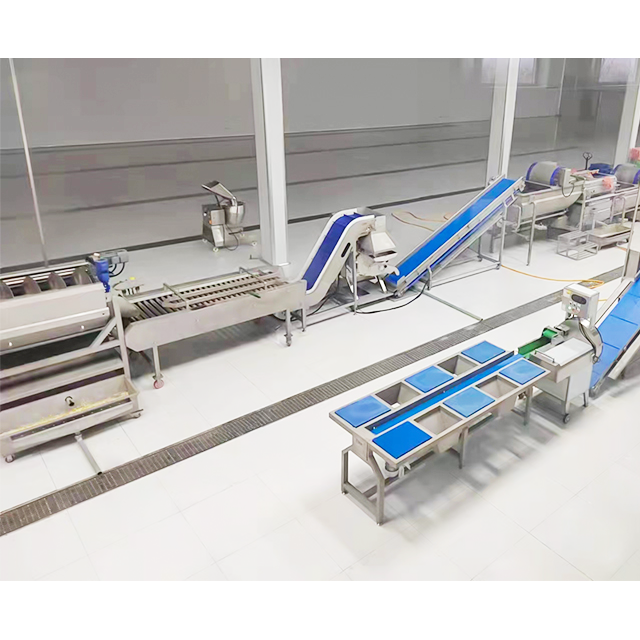 This article explores fruit and vegetable washing line design for 2026, focusing on organic produce compliance, post-wash drying, and optical sorting. It compares bubble, brush, spray, and ultrasonic washing technologies; explains air-knife and centrifugal drying; outlines four capacity tiers; and identifies five industry trends and five common purchasing errors. The guide is written for processors serving organic, fresh-cut, and export markets who need practical, mechanical equipment selection advice.Industry Insights
 -
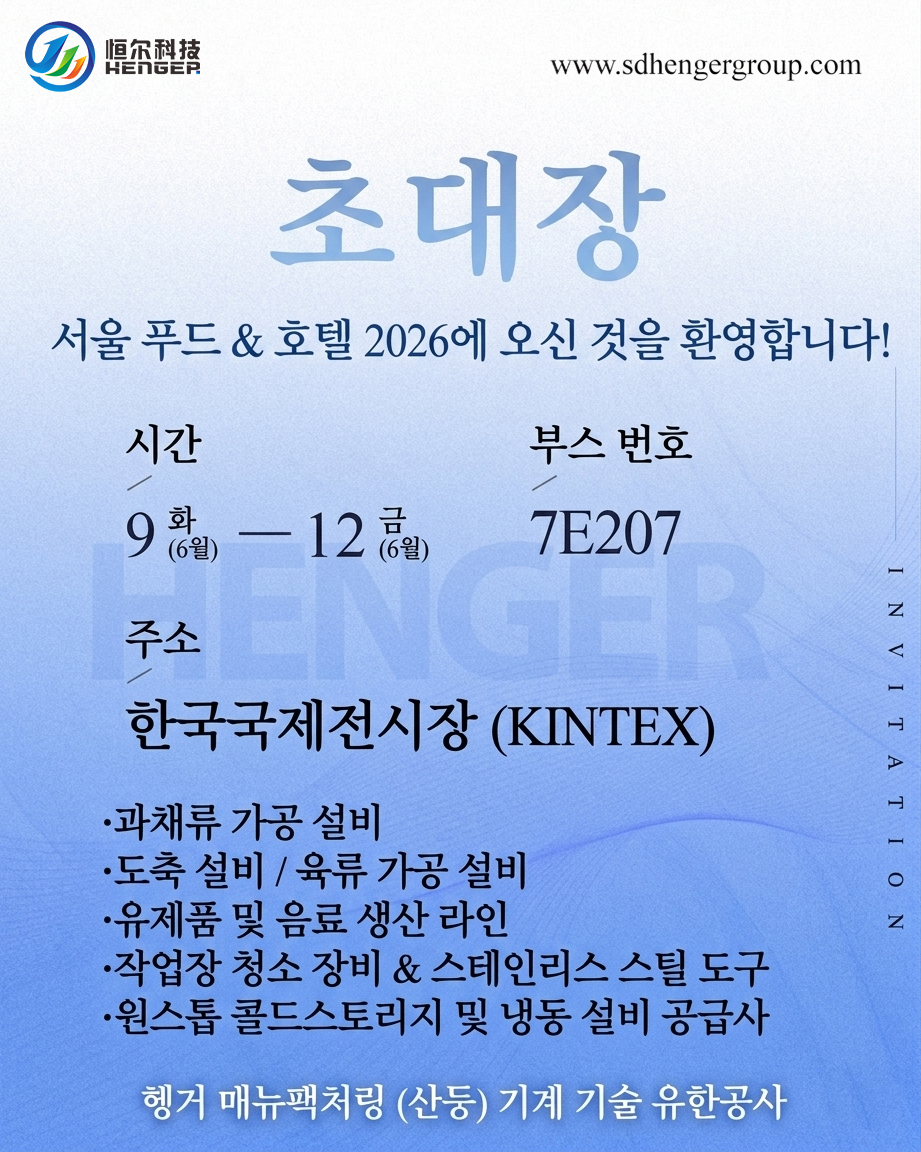 You're Invited: Meet Henger at Seoul Food & Hotel 2026!안녕하세요,We are thrilled to invite you to connect with Henger Manufacturing (Shandong) Machinery Technology Co., Ltd. at the upcoming Seoul Food & Hotel 2026, the premier food processing and hospitality industry event in South Korea! Event DatCompany Dynamic
