

Cold Room Equipment: Temperature Zone Architecture, Panel Technology Selection & Energy Efficiency for 2026 Food Processing Facilities


Cold Room Equipment: Temperature Zone Architecture, Panel Technology Selection & Energy Efficiency for 2026 Food Processing Facilities
The global cold storage equipment market reached $22.4 billion in 2025 and is projected to nearly double to $44.9 billion by 2032 at a 10.5% CAGR, driven by expanding frozen food consumption, stricter food safety regulations, and cold chain infrastructure build-outs across Asia-Pacific — a region accounting for 52% of global cold storage growth. For meat processors, dairy facilities, fruit distributors, and central kitchen operators, cold room equipment is essential infrastructure — a backbone of product integrity, shelf-life extension, and regulatory compliance.
Yet many facilities still approach cold storage as a single refrigerated box rather than a system of temperature zones, panel technologies, and compressor strategies that need to work together. This guide addresses those gaps with a structured five-zone temperature model, three panel technology comparisons, compressor system selection criteria, energy efficiency strategies, and four-tier capacity planning tailored to 2026 market realities.
1. Five Temperature Zones: Matching Room Type to Product Category
Different food products require different storage temperatures. Specifying one cold room for all categories is one of the most common and costly design errors in food processing facilities. The five-zone framework below maps temperature ranges to specific product categories and processing stages.
| Zone Type | Temperature Range | Primary Application | Panel Thickness (PU) |
|---|---|---|---|
| Fresh / Chilling Room | 0 to 4 °C | Fruit and vegetable preservation, fresh dairy storage, post-slaughter carcass conditioning and pre-cooling | 100 mm |
| Processing Room | -10 to -12 °C | Intermediate temperature processing zone for portioning, cutting, and preparation of semi-frozen products | 120 mm |
| Frozen Storage Room | -18 to -20 °C | Long-term storage of frozen meat, seafood, processed foods, and bulk frozen ingredients | 150 mm |
| Quick-Freeze Room (Blast Freezer) | -30 to -35 °C | Rapid freezing of meat, aquatic products, and prepared meals; preserves product quality and supports batch continuous operation | 200 mm |
| Carcass Chilling Room | 0 to 4 °C | Post-slaughter carcass conditioning — a core quality-enhancing step that improves meat texture, tenderness, and safety | 100 mm |
Design Principle: Blast freezers should move product through the maximum ice crystal formation zone (-1 to -5 °C) as rapidly as possible. Slow passage through this zone creates large ice crystals that rupture cell walls, causing drip loss and texture degradation upon thawing. A properly sized blast freezer achieves a core temperature reduction from +70 °C to -18 °C within 240 minutes for standard meat cuts and within 90 minutes for smaller portions.
A carcass chilling room operating at 0-4 °C is not merely a storage room — it is a quality processing stage. Post-slaughter conditioning (rigor mortis resolution) at controlled temperature improves meat tenderness by 15-20% compared to uncontrolled ambient cooling. This is why slaughter lines integrate chilling rooms as a critical processing step, not merely a storage add-on.
2. Three Panel Technologies: PU, XPS, and Sanitary Stainless Steel
Cold room panel selection determines thermal performance, hygiene compliance, and long-term operating costs. Three panel technologies serve different budget and application scenarios — all complying with food-grade safety standards and HACCP requirements.
2.1 High-Density Polyurethane (PU) Panels — Mainstream Choice
PU panels are a widely adopted industry standard for commercial and industrial cold rooms. With a thermal conductivity of approximately 0.022 W/m·K, PU foam provides lower thermal conductivity per unit thickness compared to alternative materials. The closed-cell structure resists moisture absorption (less than 3% water uptake), maintaining insulation performance for 20-30 years. PU panels feature cam-lock tongue-and-groove joints that create airtight seals, reducing thermal bridging at panel connections. Core density of 40 kg/m³ is standard for chilling rooms; 42-45 kg/m³ is recommended for freezer applications where greater structural rigidity is required.
2.2 XPS Extruded Panels — Budget-Conscious Alternative
Extruded polystyrene (XPS) panels offer a lower-cost option with a thermal conductivity of approximately 0.035 W/m·K. While XPS requires approximately 50% greater thickness to match PU's thermal resistance, it provides adequate performance for chilling rooms operating above 0 °C. XPS is not recommended for freezer applications below -10 °C due to higher moisture permeability over extended service life. Facilities with moderate budget constraints and chilling-only requirements can benefit from XPS panels in non-critical storage zones.
2.3 Sanitary / Stainless Steel Panels — Hygiene-Critical Applications
For facilities requiring high hygiene standards — meat processing plants, dairy facilities, and pharmaceutical-adjacent food storage — sanitary panels with stainless steel 304 facing meet stringent sanitation protocols. The smooth, non-porous surface resists bacterial colonization, withstands high-pressure washdown cleaning, and complies with HACCP requirements for food contact surfaces. All panel joints are sealed with food-grade sealant and coved at floor junctions to a minimum height of 50 mm, a detail checked during food safety audits.
3. Compressor System Selection: Matching Capacity to Temperature Load
The compressor system accounts for up to 70% of cold room construction cost and determines long-term energy consumption — refrigeration systems consume 60-70% of total facility energy in cold storage operations. Three factors govern compressor selection.
3.1 Compressor Brand Configuration
Flexible compressor configuration allows matching renowned brands — German, Italian, or Japanese manufacturers — to project budget and performance requirements. German semi-hermetic compressors are widely adopted in industrial freezer applications where reliability thresholds exceed commercial benchmarks. Italian brands offer favorable price-to-performance ratios for medium-temperature chilling rooms. Japanese compressors are well-suited for compact-footprint installations where space optimization is a priority.
3.2 Refrigerant Strategy
The Kigali Amendment phase-down of high-GWP hydrofluorocarbons is accelerating the shift toward natural refrigerants. Ammonia (R-717) remains a leading choice for large-scale industrial cold storage due to favorable thermodynamic efficiency and zero ozone depletion potential. CO₂ (R-744) transcritical systems are gaining rapidly, particularly in Northern Europe, for their low GWP (equal to 1) and favorable performance in medium-temperature applications. Many modern facilities adopt ammonia/CO₂ cascade systems that combine both refrigerants' advantages. For transitional projects, R-448A and R-449A blends offer a bridge from legacy HFC systems while awaiting long-term natural refrigerant solutions.
3.3 Redundancy and Defrost Strategy
Critical cold rooms should specify dual compressor configurations with automatic switchover — a single compressor failure in a blast freezer can compromise an entire product batch within hours. Defrost strategy selection depends on room temperature: electric defrost for chilling rooms above 0 °C, hot-gas defrost for freezer rooms below -18 °C. Off-cycle defrost is suitable only for rooms operating above 2 °C where natural ambient heat can melt frost accumulation.
4. Four-Tier Capacity Planning Framework
Cold room capacity planning must account for current storage volume, product mix, and future expansion flexibility. The framework below scales from a small processing facility to a large cold chain distribution hub.
| Tier | Storage Volume | Product Categories | Room Configuration | Compressor Capacity | Typical Application |
|---|---|---|---|---|---|
| Tier 1 — Small Facility | 20-50 m³ | 1-2 categories | 1 chilling room (0-4 °C) + 1 freezer (-18 °C) | Single compressor, 5-10 HP | Small slaughterhouse, local dairy |
| Tier 2 — Medium Facility | 50-200 m³ | 2-4 categories | Chilling + processing (-12 °C) + frozen storage + blast freezer | Dual compressor, 15-30 HP | Regional meat processor, fruit distributor |
| Tier 3 — Large Facility | 200-1,000 m³ | 4+ categories | Multi-zone: chilling, processing, frozen storage, blast freezer, carcass chilling | Dual compressor with redundancy, 40-80 HP | Integrated slaughter line, central kitchen hub |
| Tier 4 — Distribution Hub | 1,000+ m³ | Full cold chain | Dedicated zones per temperature range with automated temperature monitoring | Multiple compressor banks, 100+ HP | Cold chain logistics center, multi-tenant food park |
Scaling Rule: The bottleneck at every tier is blast freezer capacity, not storage volume. Undersized blast freezing creates a queue of unfrozen product waiting at dangerous temperatures. Size blast freezer capacity at 120% of peak production batch output.
5. Energy Efficiency: Where Cold Room Costs Concentrate
Refrigeration systems consume 60-70% of total energy in cold storage facilities. Five strategies can reduce this share without compromising temperature performance.
5.1 Panel Thickness Optimization
Increasing PU panel thickness from 100 mm to 150 mm for a -18 °C freezer reduces compressor runtime by 25-30%, as the compressor cycles 12-14 hours per day instead of 18-20 hours. For a 500 m² freezer operating 365 days, this translates to approximately 35-40% annual energy savings — recovering the panel cost premium within 2-3 years.
5.2 Door Management and Air Curtain Integration
Every cold room door opening exchanges warm ambient air with cold internal air, creating moisture load and thermal infiltration. Strip curtains reduce air exchange by 60-70%; automatic door closers limit open duration to 15-30 seconds. For high-traffic loading bays, air curtains maintain temperature separation while allowing continuous forklift access. A door left open for 10 minutes in a -18 °C freezer can trigger 2-3 hours of additional compressor runtime to recover target temperature.
5.3 Condenser Heat Recovery
Compressor condenser discharge heat (35-45 °C) can be captured via heat exchangers and redirected to pre-heat hot water for facility cleaning, defrost cycles, or underfloor heating for freezer frost heave prevention. Facilities integrating condenser heat recovery report 8-15% total energy reduction.
5.4 Variable-Speed Compressor Control
Variable-speed compressors modulate output to match actual cooling load rather than cycling on and off at full capacity. For facilities with variable product throughput — such as slaughter lines with batch processing schedules — variable-speed control reduces energy consumption by 15-25% compared to fixed-speed equivalents. The investment premium is typically recovered within 3-4 years of operation.
5.5 Vapor Barrier Integrity at Panel Joints
Moisture infiltration through improperly sealed panel joints degrades insulation performance by 20-40% within 5 years. All pipe and cable penetrations should be sealed with closed-cell foam and vapor-barrier tape. Thermal camera inspection during commissioning identifies thermal bridges before they become operational problems.
Under-specified panel thickness is among the most expensive false economies in cold room construction. A -25 °C freezer built with 80 mm PU panels instead of 150 mm panels will consume 35-40% more energy annually, experience condensation and ice buildup at joints within 6-12 months, and require panel replacement within 8-10 years — versus 25-30 years for correctly specified panels.
6. Five Trends Shaping Cold Room Equipment in 2026
6.1 Natural Refrigerant Transition Accelerating Under Regulatory Pressure
The Kigali Amendment and EU F-Gas Regulation are driving cold room operators to accelerate replacement of HFC-based systems beyond normal depreciation schedules. CO₂ transcritical systems are gaining traction in the industrial freezer segment as food processors adopt the technology for its zero ozone-depletion properties and favorable lifecycle cost profiles in moderate climates. German and Scandinavian operators are retrofitting ammonia-CO₂ cascade systems at a notable pace.
6.2 IoT-Enabled Temperature Monitoring Becoming Standard
Approximately 65% of new cold storage installations in 2026 include IoT-enabled temperature tracking features — up from 40% in 2023. Real-time monitoring with remote alerts enables operators to detect temperature excursions before product quality is compromised. HACCP documentation that previously required manual log entries is now generated automatically by sensor networks, satisfying audit requirements without dedicated staff time.
6.3 Modular Cold Room Construction Enabling Rapid Deployment
Prefabricated cam-lock panel systems install 50-60% faster than site-built cold rooms. A 500 m² cold storage facility can be enclosed in 10-15 days versus 4-6 weeks for conventional construction. Modular architecture allows phased expansion — a Tier 1 facility can grow into a Tier 3 hub by adding chambers without demolishing existing structures. This flexibility is particularly valuable in emerging markets where demand growth is difficult to forecast.
6.4 Cold Chain Infrastructure Expansion in Asia-Pacific
Asia-Pacific accounts for 52% of global cold storage market growth, driven by growing demand for frozen and chilled foods, expanding pharmaceutical cold chain networks, and steady growth in food processing capacity across emerging economies. Government-led efforts to reduce post-harvest losses in India and Southeast Asia are funding cold chain infrastructure at significant scale, creating demand for modular, rapidly deployable cold room solutions.
6.5 Food Safety Compliance Driving Equipment Specification
The FDA's Food Safety Modernization Act (FSMA) Section 204 now mandates electronic traceability for temperature-controlled foods, making cold storage equipment decisions a compliance imperative — not just an operational choice. Temperature abuse is responsible for an estimated 30% of foodborne illness outbreaks in commercial settings. Facilities that cannot demonstrate continuous temperature monitoring face regulatory action and product recalls, driving investment in equipment with integrated data-logging capabilities.
7. Five Common Design Errors — And How to Avoid Them
- Single cold room for all product categories: Fresh produce, frozen meat, and blast-frozen products require different temperatures and humidity levels. A single room compromises every category. Fix: Minimum two separate rooms (0-4 °C for fresh, -18 °C for frozen) even at Tier 1.
- Under-specified panel thickness for freezer applications: 80 mm panels in a -25 °C freezer cause excessive compressor runtime, condensation, and premature panel failure. Fix: Specify 150 mm PU minimum for -18 °C rooms; 200 mm for blast freezers at -35 °C.
- Missing floor insulation in freezer rooms: Without floor PU panels or rigid foam insulation, moisture in the substrate freezes and expands, cracking the floor slab — a condition called frost heave. Fix: Install floor insulation for all rooms operating below -10 °C.
- No vapor barrier at penetrations: Unsealed pipe and cable penetrations allow warm, moist air to enter the panel structure, degrading insulation from within. Fix: Seal all penetrations with closed-cell foam and vapor-barrier tape during commissioning.
- Undersized blast freezer capacity: One of the most critical errors. Production capacity is planned generously, but blast freezer capacity is often calculated for average rather than peak batch output. Fix: Size blast freezer capacity at 120% of peak production batch output.
8. Supplier Selection Criteria for Cold Room Equipment
Choosing cold room equipment requires evaluating suppliers on criteria that extend beyond individual panel or compressor specifications.
- Integrated solution capability: Does the supplier offer panels, doors, compressors, and temperature monitoring as an integrated package — or only individual components requiring multi-vendor coordination?
- Panel technology range: Can the supplier provide PU, XPS, and sanitary stainless steel panels, or are they limited to a single panel type?
- Compressor brand flexibility: Can the supplier configure compressors from multiple renowned brands (German, Italian, Japanese) to match project budget and performance requirements?
- Engineering design support: Does the supplier provide professional engineering design for temperature zone layout, capacity planning, and regulatory compliance documentation?
- HACCP compliance documentation: Does the equipment configuration generate temperature records suitable for regulatory audits, including FSMA Section 204 electronic traceability requirements?
- After-sales service and spare parts availability: For facilities operating 24/7, how quickly can technical support respond — and are spare parts stocked regionally?
An integrated supplier who provides cold room panels, doors, compressor systems, and engineering design as a one-stop solution can reduce the coordination complexity that multi-vendor configurations can create — ensuring that temperature zones, panel technologies, and compressor capacities work together as a system rather than as isolated components.
Planning Cold Storage for Your 2026 Facility?
Henger Manufacturing (Shandong) Machinery Technology Co., Ltd. provides integrated cold room equipment across five temperature zones — with PU, XPS, and sanitary stainless steel panel options, flexible compressor configuration, and professional engineering design tailored to food processing, slaughter, dairy, and central kitchen applications.
Explore our Cold Room Equipment Solutions | Contact Our Engineering Team
Related News
-
-
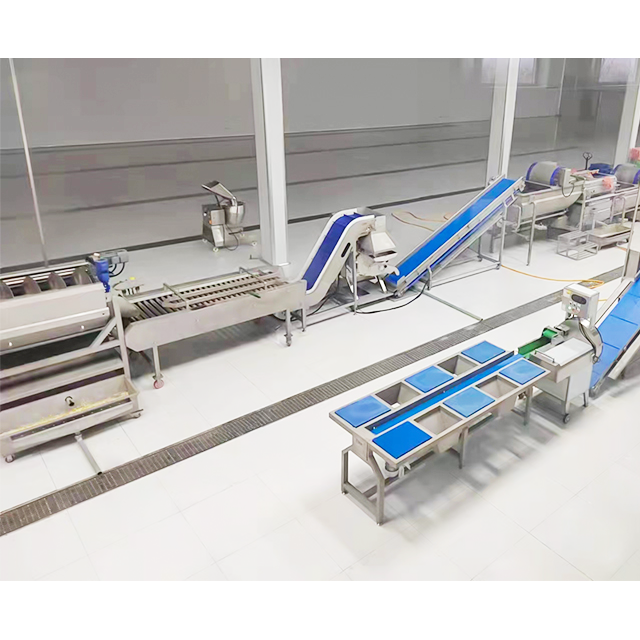 This article explores fruit and vegetable washing line design for 2026, focusing on organic produce compliance, post-wash drying, and optical sorting. It compares bubble, brush, spray, and ultrasonic washing technologies; explains air-knife and centrifugal drying; outlines four capacity tiers; and identifies five industry trends and five common purchasing errors. The guide is written for processors serving organic, fresh-cut, and export markets who need practical, mechanical equipment selection advice.Industry Insights
 -
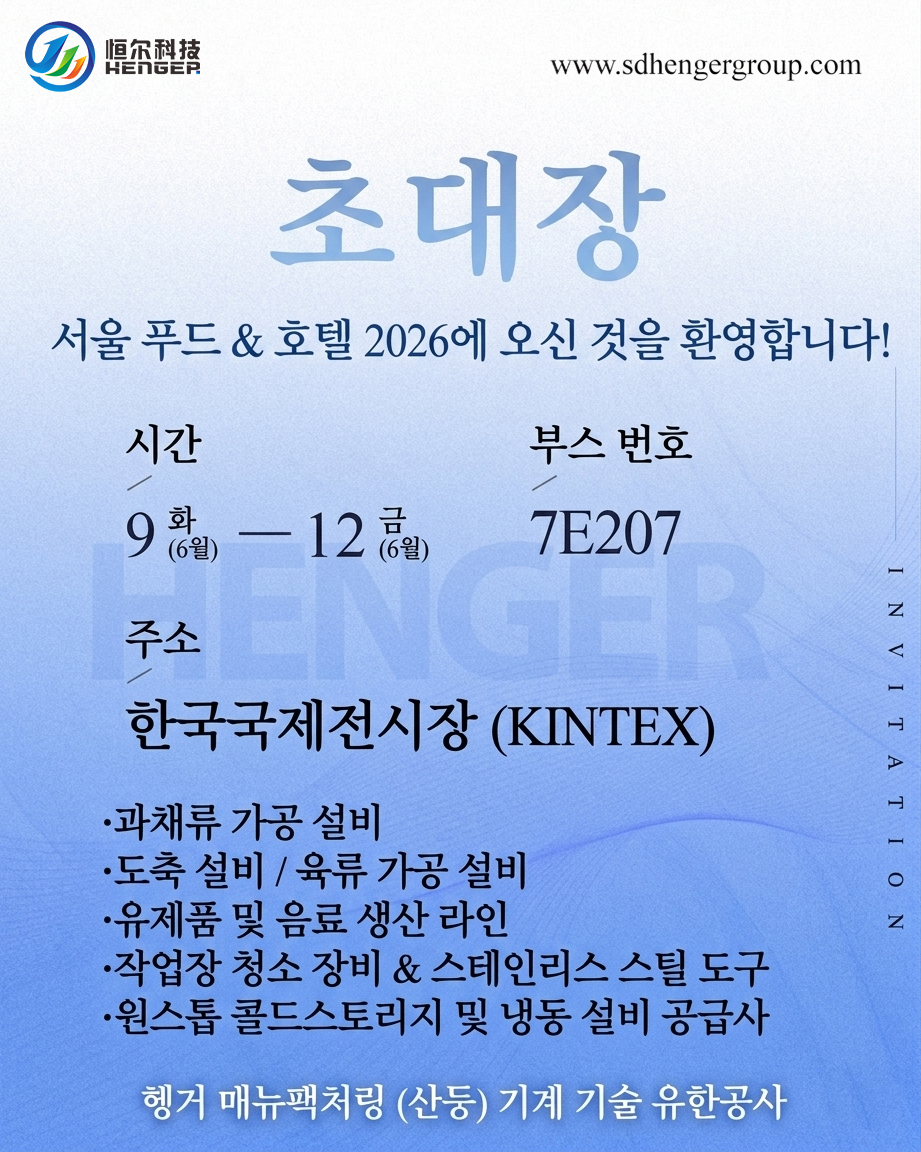 You're Invited: Meet Henger at Seoul Food & Hotel 2026!안녕하세요,We are thrilled to invite you to connect with Henger Manufacturing (Shandong) Machinery Technology Co., Ltd. at the upcoming Seoul Food & Hotel 2026, the premier food processing and hospitality industry event in South Korea! Event DatCompany Dynamic
