The global fruit and vegetable processing equipment market is projected to grow from $7.86 billion in 2025 to $14.04 billion by 2034, expanding at a CAGR of 6.66% (VMR, 2026). Within this broader market, the industrial fruit and vegetable washing machine segment alone is valued at $36.65 million in 2026 and forecast to reach $64.04 million by 2035 at a CAGR of 6.4% (Industry Research Biz, 2026). A parallel estimate from Pmarket Research places the wider fruit and vegetable cleaning equipment market at roughly $2.8 billion with a CAGR of 7.1–7.8%, underscoring the explosive demand.
Several converging forces are driving this growth. In 2025, urban retail channels saw a 34% increase in packaged vegetable consumption and a 29% rise in pre-cut fruit products. Consumer surveys show that 68% of UK shoppers actively seek pesticide-free fruit, while 54% of US buyers are willing to pay a premium for "triple-washed" leafy greens. Regulatory pressure is equally significant — the US Food Safety Modernization Act (FSMA) has driven 68% of North American facilities to upgrade their washing equipment, and the European Union's Regulation 852/2004 is accelerating adoption of chemical-free sanitisation technologies such as electrolysed water and ozone treatment.
Whether you are building a fresh-cut salad plant, upgrading a root vegetable processing facility, or setting up a tropical fruit export operation, the washing line you choose directly determines product safety, shelf life, and compliance readiness. This guide covers the four primary washing technologies, core equipment configurations, water recycling strategies, and the practical considerations that matter most when specifying a fruit and vegetable washing line in 2026.
The Four Main Washing Technologies: How They Compare
Not all produce washing is created equal. The right technology depends on the type of produce, the contaminants you need to remove, and your throughput requirements. Here is a practical comparison of the four most widely used methods.
| Technology | How It Works | Best Suited For | Key Advantage |
|---|---|---|---|
| Bubble (Air Agitation) Washing | Compressed air generates bubbles through a perforated plate at the tank bottom, creating vigorous agitation that loosens soil and pesticide residues | Leafy greens, root vegetables, tomatoes, peppers, most common vegetables | Reduces pesticide residues by up to 92%; gentle on delicate produce; handles high volumes |
| Drum / Rotary Washing | Produce tumbles inside a rotating perforated drum while high-pressure spray nozzles rinse the surface | Root vegetables (potatoes, carrots, beets), hard fruits (apples, citrus), stone fruits | Effective abrasion for heavily soiled crops; continuous throughput; low manual intervention |
| Ultrasonic Washing | High-frequency sound waves generate cavitation bubbles that implode on produce surfaces, dislodging contaminants at microscopic level | Berries, mushrooms, soft herbs, cut fruits, organic produce requiring chemical-free cleaning | 37% improvement in cleaning efficiency; 28% less water usage; removes microbes without chemicals |
| Spray / High-Pressure Washing | Produce travels on a mesh conveyor under strategically angled high-pressure nozzles that physically blast away soil and debris | Firm vegetables (cabbage, broccoli), whole fruits for fresh market, pre-wash stage | Simple and reliable; easy to maintain; effective for heavy soil loads; often used as first-stage wash |
In practice, most modern washing lines combine two or more of these technologies. A typical root vegetable line, for example, might use a drum washer for initial soil removal, followed by a bubble wash stage for finer cleaning, and a final high-pressure spray rinse. This multi-stage approach delivers the thorough cleaning that modern food safety standards demand.
Core Equipment Components of a Complete Washing Line
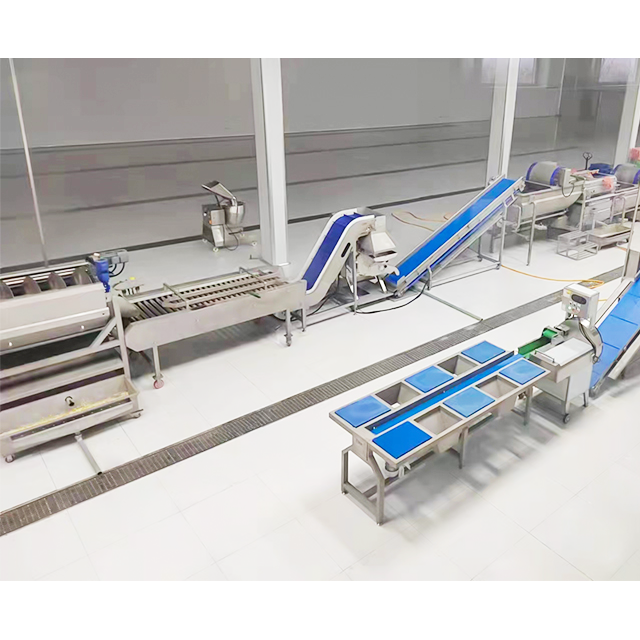
A well-designed fruit and vegetable washing line is more than just a washing machine — it is an integrated system of several components working in sequence. Understanding each component helps you evaluate proposals and identify gaps.
1. Receiving & Initial Sorting Conveyor
The process begins with a receiving conveyor — typically a belt or roller type — where raw produce is dumped from field bins or bulk containers. At this stage, workers or basic mechanical sorters remove obvious foreign objects, severely damaged items, and excess field debris. This pre-sort step protects downstream equipment from stones, branches, and other abrasive contaminants that could cause damage or contamination.
2. Pre-Wash / Primary Washing Unit
Depending on produce type, the pre-wash stage uses either a high-pressure spray system for heavy soil removal (root crops) or a bubble wash tank for lighter contamination (leafy greens, soft fruit). The pre-wash is critical because it reduces the microbial and particulate load entering the main wash stage, extending the life of wash water and improving overall sanitation effectiveness. Large facilities report that proper pre-washing can reduce water consumption in the main wash by 20–30%.
3. Main Washing Unit
This is the heart of the line. Bubble washers — the most widely deployed technology — feature a stainless-steel tank with an air blower system, adjustable bubble intensity, and a water circulation pump. The produce residence time in the tank is adjustable, typically ranging from 2 to 8 minutes depending on the crop and contamination level. Modern units incorporate variable-frequency drives (VFDs) for the conveyor and blower, allowing operators to fine-tune agitation intensity without stopping the line.
4. Secondary Rinse & Sanitisation
After the main wash, produce passes through a clean-water rinse stage. This is where sanitisation technologies are often integrated. The three most common options in 2026 are:
| Sanitisation Method | Mechanism | Effectiveness | Considerations |
|---|---|---|---|
| Ozone Treatment | Ozone gas dissolved in wash water oxidises bacteria, viruses, and pesticide molecules | Removes up to 95% of microbial contamination | Adoption growing 41% annually; no chemical residue; requires ozone generator equipment |
| UV-C Disinfection | Ultraviolet light at 254nm wavelength destroys microbial DNA | Reduces bacterial contamination by up to 96% | Non-chemical; effective for surface treatment; limited penetration on rough surfaces |
| Electrolysed Water (EW) | Electrolysis of salt water generates hypochlorous acid solution for sanitisation | Strong antimicrobial efficacy against bacteria and viruses | EU 852/2004 compliance driver; requires on-site generation unit; low operating cost |
5. Dewatering / Air Drying
After rinsing, excess water must be removed before packaging or further processing. This is typically achieved with a vibratory dewatering screen, a centrifugal dryer, or an air knife drying system. Air knife systems are increasingly popular because they use high-velocity air streams to blow water off produce surfaces without mechanical contact, making them ideal for delicate items such as berries, herbs, and pre-cut vegetables. Proper drying is essential — residual moisture accelerates microbial growth and reduces shelf life significantly.
6. Water Treatment & Recycling System
Water is one of the largest operating costs in any washing line. In 2026, 49% of newly installed systems include water recycling equipment, reducing water waste by up to 45%. A typical water recycling loop includes sedimentation tanks for removing suspended solids, sand filters or drum filters for finer particulate removal, and in some cases, UV or ozone treatment to maintain water quality for recirculation. Facilities in water-scarce regions — particularly California, where 82% of Central Valley packing operations have adopted water-saving equipment — are leading adoption of closed-loop systems. Israeli facilities have achieved water recovery rates of up to 92%, setting a benchmark for the industry.
Capacity Planning: Matching Line Configuration to Your Throughput
Washing line capacity is typically measured in tonnes per hour (t/h) and depends on the produce type, washing stage count, and equipment sizing. The following table provides practical reference points for common facility scales.
| Facility Scale | Capacity Range | Typical Configuration | Best Suited For |
|---|---|---|---|
| Small / Startup | 0.5 – 2 t/h | Single bubble wash tank + spray rinse + manual sorting | Local cooperatives, farm-gate operations, trial production |
| Medium | 2 – 8 t/h | Bubble wash + drum wash + ozone sanitisation + air drying + basic water recycling | Regional processors, fresh-cut salad plants, fruit packing houses |
| Large | 8 – 20 t/h | Multi-stage wash (spray pre-wash + bubble + drum) + UV/ozone + air knives + closed-loop water recycling + CIP | National processors, export-oriented facilities, multi-product operations |
| Industrial | 20 – 58+ t/h | Full automated line with inline sorting, multi-stage washing, sanitisation, drying, water recycling, and centralised control | Major food groups, vertically integrated operations, high-volume contract packers |
When specifying capacity, it is important to account for peak-season volume rather than average daily throughput. Many processors underestimate their seasonal surge — berry harvests, for example, may concentrate 40% of annual volume into a 6-week window. Over-specifying by 20–30% is generally more cost-effective than losing product during peak season due to line bottlenecks.
Five Key Trends Shaping the Washing Equipment Market in 2026
Trend 1: Automated CIP Integration
By 2023, 85% of newly launched washing equipment models incorporated automated clean-in-place (CIP) functionality, up from just 27% in 2019. CIP integration reduces manual cleaning labour, ensures consistent sanitation between product changeovers, and provides digital records for food safety audits. For multi-product facilities that switch between different crop types throughout the day, CIP capability is no longer optional — it is an operational necessity.
Trend 2: Water Recycling Becomes Standard
With water costs rising and regulatory pressure mounting globally, water recycling has moved from "nice to have" to baseline specification. The combination of sedimentation, filtration, and sanitisation recirculation can reduce fresh water consumption by 40–50%. In drought-prone regions, some facilities are achieving 80%+ recycling rates through multi-pass filtration and ozone treatment. Expect this trend to accelerate as climate-driven water scarcity intensifies.
Trend 3: Chemical-Free Sanitisation Demand
The organic produce market is growing at a CAGR of 9.7%, and organic certification prohibits the use of synthetic chemical sanitisers on produce. This has driven strong interest in ozone, UV-C, and electrolysed water systems. Ozone treatment adoption alone has grown 41% year-on-year, driven by its ability to eliminate up to 95% of microbial contamination without leaving chemical residues. Processors targeting both conventional and organic markets are increasingly specifying dual-capability lines that can switch between chemical and non-chemical sanitisation modes.
Trend 4: Asia-Pacific Expansion
Asia-Pacific accounts for 39% of global industrial washing equipment demand — the largest regional share — with China alone representing 41% of that regional demand. Rapid urbanisation, rising supermarket penetration, and tightening food safety regulations across Southeast Asia are fuelling investment. Indonesia's market grew 63% between 2020 and 2023, and India is seeing a 41% annual increase in commercial ultrasonic washing machine adoption driven by pesticide residue concerns. For equipment suppliers and processors targeting these growth markets, understanding local regulatory frameworks and water quality conditions is essential.
Trend 5: Smart Monitoring and Sensor Integration
Sensor-based monitoring systems are being adopted across 52% of new installations, providing real-time data on water quality, turbidity, temperature, pH, and conveyor speed. While the most sophisticated systems incorporate data logging for traceability and food safety audit compliance, even basic sensor packages — monitoring wash water turbidity and automatically triggering freshwater replenishment — deliver meaningful improvements in wash consistency and product quality. The key is to specify monitoring systems that match your facility's actual technical capability and compliance requirements, rather than over-investing in features that will not be used.
Practical Considerations When Selecting a Washing Line Supplier
Beyond the technology itself, several practical factors determine whether a washing line delivers on its promise over years of operation:
Material quality: All food-contact surfaces should be 304 or 316L stainless steel. Lower-grade materials corrode faster in the wet, often chemical-laden wash environment, leading to contamination risks and costly replacements.
Modularity: Modular systems that allow you to add stages (such as an ozone injection module or a second wash tank) without replacing the entire line provide valuable flexibility as your product range or volume evolves.
After-sales support: Washing lines operate in demanding, continuously wet conditions. Access to spare parts, technical support, and preventive maintenance service is critical — particularly for facilities in regions where local engineering expertise may be limited.
Compliance documentation: Your equipment supplier should provide documentation supporting food contact material compliance, electrical safety certification, and cleaning validation protocols. These documents are essential for regulatory inspections and customer audits.
Energy efficiency: Pumps, blowers, and conveyors are the primary energy consumers. Systems with variable-frequency drives and energy-efficient motors can reduce electrical consumption by 15–25% compared to fixed-speed alternatives.
Conclusion
The fruit and vegetable washing line market in 2026 is characterised by strong growth, tightening regulatory requirements, and rapidly evolving technology. The convergence of consumer demand for cleaner produce, water scarcity concerns, and automated CIP integration means that washing line decisions made today will shape operational efficiency and compliance posture for years to come.
The most effective approach is to work with an experienced equipment partner who understands both the technology and the practical realities of food processing across different markets. Whether you need a compact bubble washing system for a single-product facility or a multi-stage, multi-technology line for a large-scale operation, the right configuration exists — but only if it is specified correctly from the start.
SD Henger Group has been designing and manufacturing fruit and vegetable washing lines for food processing facilities across more than 100 countries. Our engineering team can help you evaluate your specific produce types, throughput targets, and regulatory environment to recommend the most effective washing line configuration for your operation.
Contact Our Team Today →